UAE’s one-stop shop for tools, power & hand tools, water, sewage & vacuum pumps, air compressors & generators.
what-are-the-advantages-of-using-a-power-trowel

What Are the Advantages of Using a Power Trowel?

Concrete finishing is a critical stage in construction that affects both the appearance and durability of floors and slabs. In the UAE, where construction projects range from luxury commercial complexes to expansive industrial facilities, achieving high-quality concrete finishes is essential. 

This article explores the advantages of using a power trowel in the UAE construction industry, supported by professional insights, case examples, and industry data.

Introduction to Power Trowels

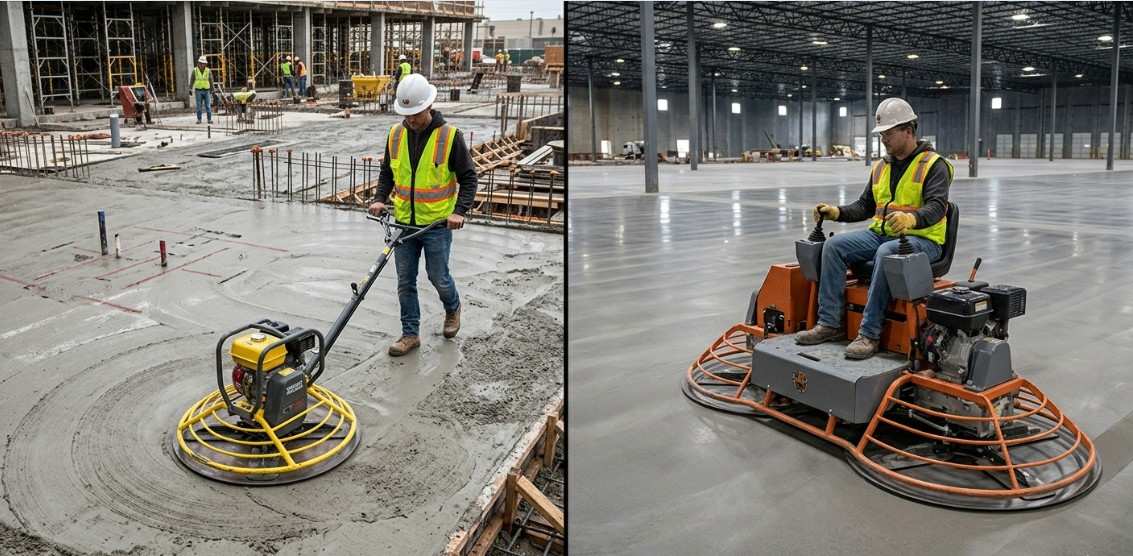
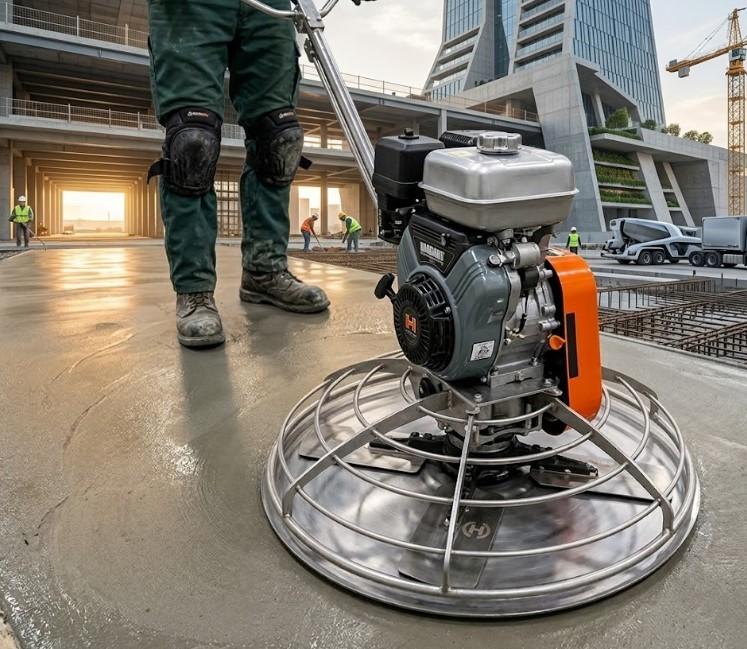
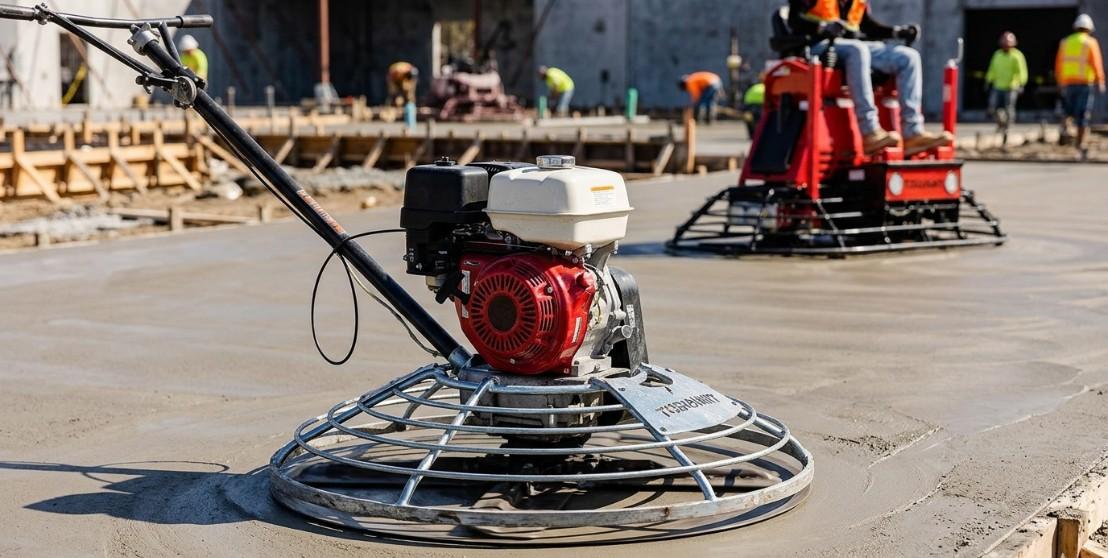
A power trowel, also known as a mechanical trowel or power float, is equipped with rotating blades that evenly smooth freshly poured concrete. These machines are used in projects where large slabs or high-quality finishes are required. In the UAE, construction sites frequently employ both walk-behind models for medium surfaces and ride-on models for large commercial and industrial areas. 

The adoption of power trowels in the UAE has grown because they increase productivity and provide a consistent, professional finish that manual methods cannot easily achieve. For a detailed explanation of models, usage tips, and maintenance, check out our power trowel complete guide to make the right choice for your project.

Key Advantages of Using a Power Trowel

Increased Efficiency and Speed

One of the most significant advantages of using a power trowel is the efficiency it brings to construction projects. Power trowels cover large areas in a fraction of the time compared to hand trowels. 

To achieve faster coverage on large slabs without compromising quality, many UAE contractors rely on a variety of power trowels that are designed for both walk-behind and ride-on applications.

Productivity Gains in the UAE

  • Large slab coverage: Power trowels can finish thousands of square meters in a single day, which is ideal for expansive UAE projects such as airport terminals and industrial warehouses.
  • Reduced labor costs: One operator using a power trowel can replace several workers performing manual finishing, lowering overall labor expenses.
  • Faster project completion: Shorter timelines enable UAE contractors to meet client deadlines and reduce project overheads, providing a competitive advantage in the local construction market.

Consistent and High‑Quality Finish

A power trowel delivers uniform, professional‑grade surface finishes that are difficult to achieve with hand tools alone. The rotating blades apply even pressure across the entire surface area, eliminating common imperfections like ridges, uneven sections, or inconsistent gloss levels.

Structural and Aesthetic Benefits

The quality of the finish obtained with power trowels is crucial for both form and function:

  • Consistent flatness: Uniform blade pressure ensures surfaces are level with minimal variation, reducing potential water pooling or wear issues.
  • Enhanced density and compaction: Mechanical finishing compresses the concrete, squeezing out excess water and reducing porosity. This results in stronger slabs that are less susceptible to cracking or premature surface degradation.
  • Aesthetic appeal: Depending on blade settings, power trowels can create finishes ranging from smooth matte surfaces to glossy polished floors suitable even for architectural or retail environments.

Contractors often find that clients are willing to pay a premium for floors with superior finish quality because they enhance both look and durability.

Reduced Physical Labor and Safety Advantages

Manual finishing is physically demanding and can contribute to worker fatigue, repetitive stress injuries, and slower job progress. Power trowels shift the physical workload from workers to machinery, dramatically reducing the physical labor required on site.

Operator Ease and Workplace Safety

  • Lower strain on workers: Operators guide rather than physically smooth the surface, minimizing bending, kneeling, and repetitive motions that lead to muscle fatigue.
  • Consistent operator pace: New users can achieve acceptable finish quality quickly with minimal experience, while experienced operators can fine‑tune results through blade pitch and speed controls.
  • Safety features: Modern power trowels often include guard rings, throttle controls, and other ergonomic features that improve safety and reduce on‑site accidents when operated as intended.

These benefits align with broader industry efforts to reduce workplace injuries and improve working conditions on construction sites.

Cost‑Effectiveness Over Time

Although a power trowel represents a higher initial investment than hand tools, its long‑term financial impact can be favorable, especially for contractors handling frequent or large jobs. Two key financial advantages stand out:

  1. Lower labor costs: By replacing multiple manual finishers with a single machine, contractors can reduce wages paid per project.
  2. Increased job throughput: Faster completion rates allow contractors to take on more projects within the same time frame, expanding earning potential without proportionally increasing staff.

Moreover, power trowels can be rented for occasional use, avoiding the need for full purchase and storage costs while still capturing efficiency benefits.

Versatility Across UAE Projects

Power trowels are adaptable to different types of concrete finishing, from initial floating to final polishing. In the UAE, they are widely used in:

  • Industrial facilities: Warehouses and factories requiring strong, level floors.
  • Commercial complexes: Malls, hotels, and office buildings where appearance matters.
  • Residential projects: Large villas, basements, or outdoor patios with extensive slab areas.

Ride-on models are particularly effective for expansive surfaces such as airport aprons or exhibition centers, enabling operators to finish thousands of square meters quickly and consistently. For projects requiring precise and durable finishes, the Robin power trowel SM-60 is widely used in the UAE for industrial and commercial floors, delivering professional results efficiently.

Comparison with Manual Methods

Feature Power Trowel Hand Trowel
Speed and Efficiency High, covers large areas quickly Slower, suitable for small areas
Finish Consistency Uniform and professional Dependent on user skill
Physical Effort Low High
Cost Higher initial investment Low
Best Use Large slabs and commercial projects Tight spaces or detailed work

For UAE projects, the combination of speed, quality, and labor savings makes power trowels the preferred choice for professional contractors.

Expert Insights and Case Reflections

Industry experts in the UAE emphasize that the right finishing equipment directly impacts project timelines and quality. Data from UAE construction sites show that using a power trowel can reduce finishing time by more than 50 percent compared to manual methods. 

For example, finishing a 500 square meter warehouse floor manually might require a team of six workers over a full day, whereas a single operator using a ride-on power trowel can complete the same area in a few hours while achieving a smoother, more durable finish.

AI Overview

This blog explores the advantages of using power trowels in UAE construction, highlighting efficiency, consistent finishes, reduced labor, cost savings, and versatile applications for large slabs.

FAQs

What is a power trowel used for?

A power trowel is a machine used to smooth and finish concrete surfaces after pouring, replacing manual troweling with consistent mechanical action.

How soon after pouring can you use a power trowel?

You should start using a power trowel when the concrete is firm enough to support its weight but still workable, typically when footprints remain shallow.

What types of power trowels are there?

There are walk‑behind power trowels for smaller spaces and ride‑on models for larger surfaces, both designed to improve efficiency and finish quality.

Can power trowels improve concrete durability?

Yes, by compressing and removing excess water from the surface, power trowels increase concrete density and reduce the risk of cracking.

Conclusion

Power trowels offer significant advantages for modern construction projects in the UAE, including enhanced efficiency, consistent high-quality finishes, reduced labor strain, and long-term cost savings. These machines are essential for contractors handling large commercial, industrial, and residential slabs where timelines, durability, and aesthetics are critical.

For contractors, developers, and project managers seeking reliable, high-performance concrete finishing solutions across the UAE, Al Yaqeen Hardware is a trusted supplier for businesses in the region, providing quality equipment and expert guidance to streamline construction workflows.
Ready to Optimize Your Concrete Finishing?

Contact Al Yaqeen Hardware today and discover how our power trowel solutions in Dubai can transform your construction projects across the UAE.

Expand Your Knowledge: Related Industry Guides

walk-behind-vs-ride-on-power-trowels-for-concrete-finishing

Walk‑Behind vs Ride‑On Power Trowels for Concrete Finishing

Concrete finishing is a critical stage in construction across the UAE, where large-scale infrastructure, commercial developments, and high-end residential projects demand smooth, durable, and high-performance concrete surfaces. Power trowels play a central role in achieving these finishes by compacting and polishing freshly poured concrete.

Among the available options, walk-behind and ride-on power trowels are the two most widely used machines. Choosing between them significantly impacts productivity, finish quality, labor costs, and project timelines. This guide provides a detailed, professional comparison tailored to UAE construction conditions.

Understanding Power Trowels in UAE Construction

Power trowels, also known as power floats, are machines used to smooth and compact concrete surfaces during the finishing stage. The process involves multiple passes including floating, smoothing, and final finishing to achieve the desired surface hardness and appearance.

For a detailed overview, refer to our power trowel complete guide, which explains the multiple passes including floating, smoothing, and final finishing to achieve the desired surface hardness and appearance.

In the UAE, where high temperatures accelerate concrete setting times, efficient finishing equipment is essential to maintain quality and meet tight construction schedules.

Walk-Behind Power Trowels

Overview and Working Mechanism

Walk-behind trowels are single-rotor machines operated by a worker walking behind and guiding the equipment. Blade sizes typically range between 24 and 48 inches, making them compact and maneuverable.

Key Advantages

  • Cost-Effective Equipment: Walk-behind models have significantly lower upfront costs, making them suitable for small contractors or budget-conscious projects. Consider models like Robin power trowel SM-60 for reliable performance and easy handling on smaller sites.
  • Superior Control and Precision: Operators can physically feel the surface, allowing better control during finishing passes, especially in complex layouts.
  • Ideal for Tight Spaces: These machines can work close to walls, columns, and edges where larger machines cannot reach.
  • Lower Maintenance Requirements: Simpler mechanical systems reduce maintenance complexity and costs.

Limitations

  • Lower Productivity: Walk-behind trowels typically cover smaller areas per hour, making them inefficient for large-scale projects.
  • Higher Labor Demand: Large slabs may require multiple operators, increasing workforce costs.
  • Operator Fatigue: Continuous manual operation can lead to fatigue, affecting consistency over time.

Typical Applications

  • Residential slabs and villas
  • Small commercial spaces
  • Areas with obstacles or confined layouts
  • Edge finishing in large projects

Ride-On Power Trowels

Overview and Working Mechanism

Ride-on trowels are dual-rotor machines operated by a seated driver. These machines feature wider blade spans, higher horsepower, and advanced control systems, enabling them to cover large areas efficiently.

Key Advantages

  • High Productivity and Speed: Ride-on trowels can be up to four to five times faster than walk-behind models. For large-scale UAE projects, the Robin power trowel SM-100 delivers superior efficiency and consistent finishing results.
  • Large Area Coverage: Capable of finishing up to 10,000 square feet per hour depending on conditions.
  • Reduced Labor Costs: One operator can perform the work of multiple workers, significantly lowering manpower requirements.
  • Consistent Surface Quality: Dual rotors apply uniform pressure, producing smoother and more durable finishes.
  • Enhanced Operator Comfort and Safety: Seated operation reduces fatigue and includes safety features such as emergency shut-off systems.

Limitations

  • Higher Initial Investment: Ride-on machines are considerably more expensive than walk-behind units.
  • Limited Maneuverability: Not suitable for tight or obstructed areas.
  • Requires Skilled Operators: Proper training is necessary to achieve optimal results.
  • Higher Maintenance Complexity: Advanced systems increase maintenance requirements.

Typical Applications

  • Industrial warehouses
  • Airport runways and logistics hubs
  • Large commercial floors
  • Mega infrastructure projects

Performance Comparison: Walk-Behind vs Ride-On Power Trowels

Productivity and Efficiency

Ride-on power trowels deliver significantly faster completion rates on large slabs, typically improving productivity by 30 to 50 percent. Their dual-rotor design allows wider coverage in a single pass, which is critical for large-scale UAE projects.

A single ride-on machine can effectively replace multiple walk-behind units, reducing the number of operators required on-site. This directly improves operational efficiency while lowering overall labor costs.

Cost Analysis

Walk-behind power trowels are more affordable in terms of initial purchase and day-to-day operating expenses. They are ideal for smaller contractors or projects with limited budgets.

Ride-on trowels require a higher upfront investment, but they offer better long-term return on investment. Reduced labor requirements and faster project completion contribute to overall cost savings.

Finish Quality

Walk-behind trowels provide greater control, making them suitable for detailed finishing and edge work. Operators can closely monitor the surface and make precise adjustments during the finishing process.

Ride-on trowels deliver superior uniformity across large surfaces due to consistent blade pressure and speed. This results in a smoother, denser finish suitable for high-performance flooring applications.

Maneuverability

Walk-behind trowels are highly maneuverable and can easily operate in confined or obstructed areas. They are ideal for working around columns, walls, and tight corners.

Ride-on trowels are designed for open and unobstructed spaces where maximum efficiency can be achieved. Their larger size limits their effectiveness in restricted environments.

Walk-Behind vs Ride-On Power Trowels Comparison Table

Feature Walk-Behind Trowel Ride-On Trowel
Operation Style Manual Seated operator
Project Size Small to medium Large-scale projects
Coverage Rate 500–3,000 sq ft per hour 3,000–10,000+ sq ft per hour
Maneuverability Excellent in tight spaces Limited in confined areas
Finish Quality Moderate High precision and uniform
Operator Fatigue High Low
Cost Lower initial cost Higher investment
Training Required Minimal Moderate to high

Ride-on trowels can be up to four to five times faster than walk-behind machines due to higher power and dual rotor systems. 

Productivity and Efficiency Breakdown

Real Output Comparison

  • Walk-behind: 500 to 1,000 sq ft per hour
  • Ride-on: 3,000 to 5,000 sq ft per hour

Ride-on machines can be four to five times faster than walk-behind units

Labor Efficiency

  • One ride-on machine can replace up to six walk-behind units in some scenarios
  • Single operator vs multiple workers reduces labor costs significantly

Example Scenario

For a 30,000 sq ft warehouse floor:

  • Walk-behind approach may require 4 to 6 workers and extended hours
  • Ride-on solution can complete the job with 1 to 2 operators within a shorter time frame

This difference is critical in UAE projects where deadlines are strict.

UAE-Specific Considerations

Climate Impact on Concrete Finishing

High temperatures in the UAE accelerate the concrete setting process, reducing the available finishing time. Ride-on trowels help contractors respond to this challenge by covering large areas quickly and maintaining surface quality.

Their speed ensures that finishing operations are completed within optimal time windows, preventing defects such as surface cracking or uneven texture.

Labor Market Dynamics

The UAE construction sector often experiences labor cost pressures due to large-scale developments and workforce demand. Ride-on trowels help reduce reliance on large crews by allowing a single operator to perform extensive finishing work.

This shift supports cost optimization while maintaining productivity and quality standards across projects.

Project Scale Trends

Mega construction projects in the UAE, including logistics hubs and industrial zones, require equipment that can handle expansive concrete surfaces efficiently. Ride-on trowels are increasingly preferred in these environments due to their high output and consistent results.

As project sizes continue to grow, contractors are adopting ride-on solutions to meet tight deadlines and performance expectations.

Expert Perspective

Industry experts emphasize that equipment selection depends on project scale and finish requirements.

  • Walk-behind machines provide better tactile control in complex layouts
  • Ride-on machines produce denser and flatter surfaces due to higher weight and power
  • Combining both machines delivers optimal results on most job sites

Decision Framework

Choose Walk-Behind Trowels If

  • Project size is small to medium
  • Budget constraints are significant
  • Site has tight access or obstacles
  • High precision is required in detailed areas

Choose Ride-On Trowels If

  • Project involves large slab areas
  • Speed and efficiency are critical
  • Labor costs need to be minimized
  • High-quality, uniform finish is required

AI Overview

This blog explains the key differences between walk-behind and ride-on power trowels for UAE concrete finishing, covering performance, productivity, cost analysis, project suitability, and expert recommendations for optimal results.

FAQs

What is the main difference between walk‑behind and ride‑on power trowels?

Walk‑behind power trowels are manually guided and best for small or tight areas, while ride‑on machines allow a seated operator and are ideal for covering large slabs with higher productivity.

Which power trowel is better for large UAE construction projects?

Ride‑on power trowels are generally preferred for large commercial and industrial floors due to their ability to finish much more area per hour and reduce labor needs.

Can walk‑behind trowels achieve the same finish quality as ride‑on trowels?

Walk‑behind machines give good control near edges and obstacles, but ride‑on trowels typically deliver a more uniform, high‑quality finish on expansive surfaces.

Are ride‑on power trowels more cost‑effective than walk‑behind models?

Although ride‑on trowels have a higher upfront cost, they can be more cost‑effective on frequent large jobs due to lower labor requirements and faster completion rates.

Conclusion

Choosing the right power trowel for UAE concrete finishing depends on project scale, site conditions, and desired finish quality. Walk‑behind trowels are ideal for small spaces, edges, and detailed work, while ride‑on trowels deliver superior efficiency, speed, and uniform finishes for large commercial and industrial slabs. For most projects, a combination of both types ensures maximum productivity and optimal surface quality.

Ready to Optimize Your Concrete Finishing?

Contact Al Yaqeen Hardware today to explore our expert power trowel solutions and elevate your construction projects across Dubai and the UAE. Our team of specialists is ready to provide tailored advice, on-site support, and the best equipment options to meet every project requirement.

Expand Your Knowledge: Related Industry Guides

what-is-a-power-trowel

What Is a Power Trowel? Complete Guide for Beginners

Concrete finishing is a critical step in the construction process. It determines not only the durability and strength of a floor or slab but also its appearance and long‑term performance. 

Among the most effective machines used for concrete finishing is the power trowel, a piece of construction equipment that has revolutionized the way concrete surfaces are finished in projects of all sizes. 

This guide explains what a power trowel is, how it works, the types available, key applications, professional insights, and regional relevance, highlighting its growing use in UAE construction projects, as well as the practical knowledge a beginner needs to understand this essential tool.

Introduction to Power Trowels

A power trowel is a mechanized concrete finishing machine used to smooth and level concrete surfaces after they have been poured and initially set. In construction terminology it is also referred to as a power float or troweling machine. 

The machine consists of rotating blades mounted beneath a powered engine that travels over the concrete surface, pressing and polishing it to achieve a flat, dense finish.

Power trowels are widely used in modern construction projects due to their efficiency and ability to produce consistent surface quality that surpasses traditional hand‑finishing techniques. They are particularly valuable in commercial, industrial, and large residential projects where extensive floor areas require professional finishing.

How a Power Trowel Works

Concrete finishing involves multiple stages beginning with pouring, screeding, floating, and then troweling. The power trowel is used in the later stage after floating, when the concrete has hardened sufficiently to support the machine without being destroyed.

Experts recommend waiting until the concrete surface resists a footprint of approximately 1/8 to 1/4 inch before troweling begins.

Functional Components

A typical power trowel has several key components:

  • Engine or Motor: Provides power to the blades and may be gasoline, diesel, or electric powered.
  • Gearbox and Spider Assembly: Reduces engine speed and distributes power evenly to the blades for smooth rotation.
  • Blades and Float Pans: Blades compress and smooth the surface while float pans are used in early finishing passes to flatten and consolidate concrete.
  • Control Handles or Joysticks: Allow the operator to steer and adjust blade pitch for different finishing results.
  • Safety Ring: A protective guard surrounding the blades to prevent injury and protect adjacent surfaces.

Operating Principles

During operation the blades spin in a fan‑like pattern across the concrete surface. Operators adjust the blade angle and speed as the concrete hardens. Lower blade angles and slow speeds are used in early stages for flattening while steeper angles and faster speeds are used in later passes for smoothing and burnishing.

Types of Power Trowels

Power trowels are broadly differentiated by how the operator controls them. Each type has advantages depending on project scale and capacity.

Walk‑Behind Power Trowels

Walk‑behind power trowels are operated from behind the machine by an individual using handles with throttle and pitch control. They are suitable for small to medium concrete slabs such as garage floors, residential slabs, and light commercial projects. 

For those seeking a reliable option, the Robin power trowel SM-60 provides excellent performance and durability for everyday construction needs.

Ride‑On Power Trowels

Ride‑on power trowels are larger units with seats and control levers. They are designed for large industrial and commercial floors, high‑traffic spaces, and expansive slabs where coverage area and productivity are critical. Ride‑on models can finish hundreds of square feet per hour and significantly reduce labor time compared to walk‑behind units. 

Contractors looking for a high-capacity solution can explore the Robin power trowel SM-100, ideal for extensive UAE construction projects requiring precision and efficiency.

Key Applications of Power Trowels

Power trowels have diverse applications across multiple types of construction. Their efficiency and finishing quality make them indispensable on many job sites.

Commercial and Industrial Flooring

In commercial facilities such as shopping malls, retail centers, warehouses, and production facilities the smooth and durable finish delivered by a power trowel promotes safer working conditions, easier cleaning, and improved long‑term performance of concrete floors.

Infrastructure and Large Surface Projects

Large pavement areas such as airport runways, highway slabs, and transportation terminals demand high flatness and wear resistance. Power trowels contribute to uniform surface finishes that support traffic load and weathering.

Decorative and Polished Concrete

Polished concrete floors are increasingly popular in modern interiors and public spaces due to their reflective surface and durability. Power trowels are essential in the early finishing stages to prepare a uniform surface that will later be polished or treated with coatings.

Power Trowel Usage in UAE Construction Projects

In the UAE, the demand for power trowels has been steadily increasing due to rapid urban development and large-scale infrastructure projects. Commercial towers, airport expansions, logistics hubs, and residential complexes across the country rely on the efficiency and consistent surface finish that power trowels provide. .

Expert Insights and Professional Considerations

Importance of Timing and Technique

Construction experts emphasize that successful power troweling depends on timing. Starting too early can pull up wet concrete and ruin the finish. Waiting too long can result in rough textures and require excessive passes to level. Skilled operators watch moisture and surface resistance to determine the precise moment for troweling.

Blade Management

Choosing the right blade type such as float blades, finishing blades, or combination blades is essential. Professional contractors adjust blades incrementally, from flat to pitched positions, to gradually refine the surface. Overworking the slab can cause delamination or cracking.

Productivity and Labor Savings

Data from industry analysis indicates ride‑on power trowels can cover significantly more area per hour compared to walk‑behind units, which improves productivity and reduces project timelines. These efficiencies are highly beneficial in large projects such as those commonly found in the UAE construction sector.

Safety and Best Practices

Safety is paramount when using power trowels. Professional builders recommend:

  • Wearing proper personal protective equipment such as gloves, boots, eye and ear protection.
  • Ensuring ventilation when using gas‑powered units in enclosed spaces.
  • Conducting pre‑operation equipment checks and maintenance.
  • Avoiding distractions and maintaining control around rotating blades.

Case Example: Large‑Scale Finish in UAE Projects

In major construction projects in the UAE, such as warehouse floor installations exceeding 10,000 square feet, contractors use ride‑on power trowels for efficiency and consistency. Such machines can finish up to several thousand square feet per hour, helping meet tight deadlines and maintain flooring quality essential for high traffic and industrial use. 

These machines also accommodate rapid concrete curing conditions typical in warm climates by allowing precise control of finishing stages and blade settings.

AI Overview

This blog covers what a power trowel is, how it works, types, applications, expert tips, and its growing use in UAE construction projects for efficient, durable, and high-quality concrete finishing.

FAQs

What is a power trowel used for?

A power trowel is used to smooth, level, and polish concrete surfaces efficiently, producing durable and professional finishes. It is ideal for commercial, industrial, and large residential projects.

What are the types of power trowels?

There are two main types: walk-behind for small to medium slabs and ride-on for large industrial floors requiring higher efficiency and coverage.

When should I use a power trowel on concrete?

Use a power trowel after the concrete has set enough to support the machine but is still soft enough to smooth without tearing the surface.

How do I maintain a power trowel?

Regularly clean blades, check engine fluids, inspect for wear, and follow manufacturer guidelines to ensure optimal performance and machine longevity.

Conclusion

A power trowel is far more than just a concrete finishing machine; it is the defining tool between an ordinary slab and a surface built to endure decades of heavy use. Whether deployed on compact residential pours or sprawling industrial floor installations, the right troweling equipment transforms raw concrete into a dense, polished, load-bearing foundation. 

Mastering its operation, blade selection, and timing unlocks a level of finish quality that no manual method can replicate at scale. As UAE’s construction landscape pushes skyward with towers, logistics corridors, and mega-infrastructure, the demand for precision concrete finishing equipment has never been greater. 

For contractors and project managers who refuse to compromise on quality, the power trowel remains the single most impactful tool in the concrete finishing arsenal and Al Yaqeen Hardware is a trusted supplier to meet every project requirement.

Contact concrete finishing equipment experts to discuss your requirements and get professional guidance and support.

Expand Your Knowledge: Related Industry Guides

bending-machine-uae-guide-types-uses

What Is a Bending Machine? A Guide to Its Types & Uses

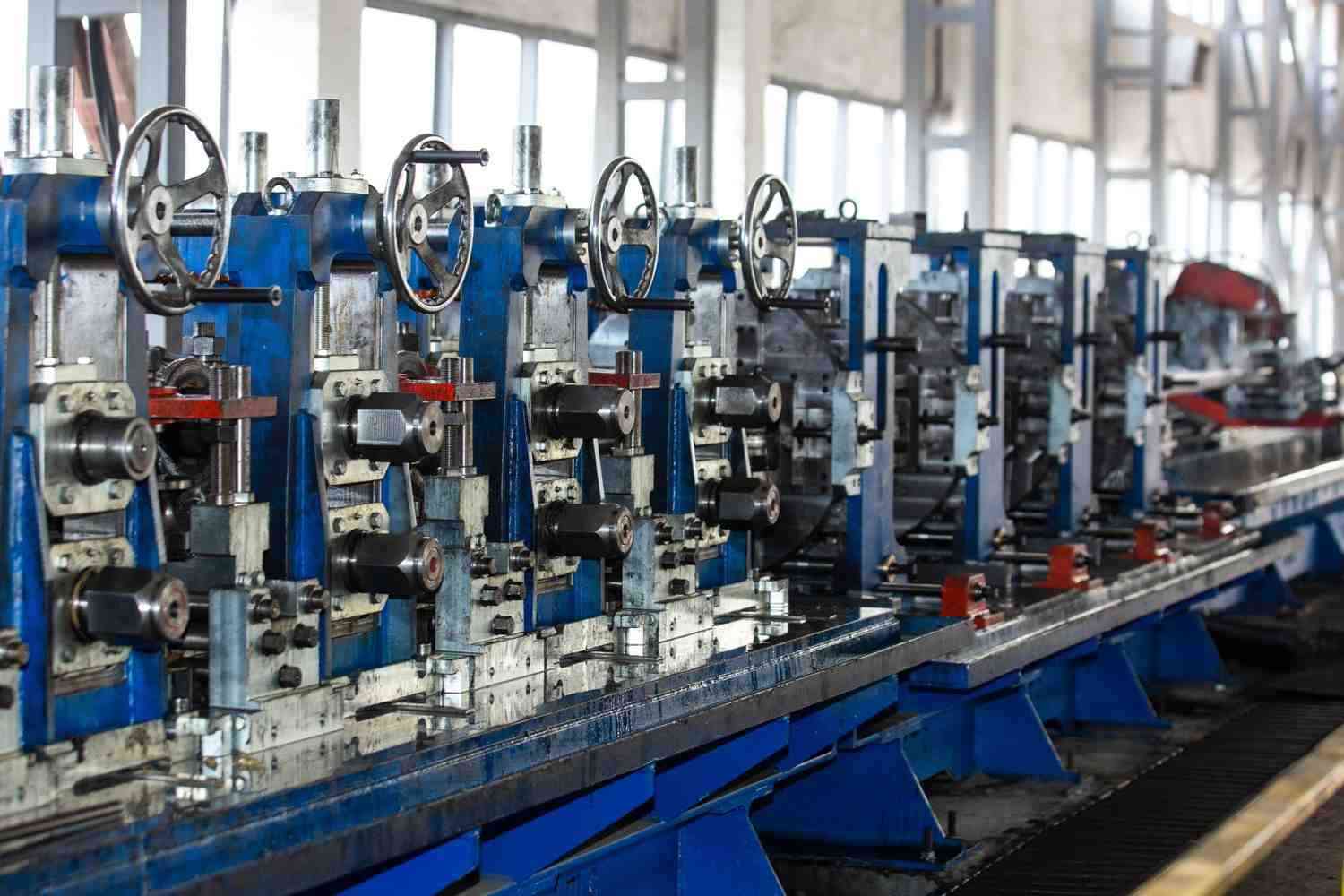
A bending machine is an industrial metal forming machine used to bend sheet metal, pipes, plates, and reinforcement bars into specific angles or curved shapes using controlled mechanical, hydraulic, or CNC-powered force. 

It plays a critical role in construction, fabrication, oil & gas, and manufacturing industries across Dubai and the UAE where precision metal shaping is essential.

How Does a Bending Machine Work?

A bending machine works on the principle of plastic deformation, meaning the metal permanently changes shape without cracking or breaking. The machine applies calculated pressure to a workpiece using tools such as punches, dies, or rollers.

The basic working process includes:

  1. Placing the metal sheet, pipe, or bar into the machine
  2. Aligning it against a die or roller system
  3. Applying mechanical or hydraulic force
  4. Controlling the bending angle and pressure
  5. Releasing the finished component

Modern CNC bending machines use computer programming to ensure exact angle accuracy and repeatable results, which is especially important for industrial-scale projects in UAE manufacturing facilities.

What Are the Main Types of Bending Machines?

Different industries require different bending solutions depending on material thickness, shape, and production volume.

What Is a Press Brake Machine?

A press brake machine is used to bend sheet metal into V, U, or custom shapes using a punch-and-die system.

Common applications include:

  • Metal cabinets
  • Electrical panels
  • HVAC ducts
  • Industrial enclosures
  • Structural brackets

CNC press brakes are widely used in Dubai fabrication workshops because they offer higher precision and automation compared to manual models.

What Is a Pipe Bending Machine?

A pipe bending machine is designed to bend pipes and tubes without collapsing their internal diameter.

It is commonly used in:

  • Plumbing systems
  • Oil & gas pipelines
  • Automotive exhaust systems
  • Structural steel frameworks

In the UAE oil and infrastructure sector, accurate pipe bending is essential for long-lasting pipeline systems.

What Is a Plate Rolling Machine?

A plate bending or rolling machine uses rollers to bend large metal plates into cylindrical or curved shapes.

It is typically used for:

  • Storage tanks
  • Silos
  • Pressure vessels
  • Industrial drums

Large-scale industrial projects in Dubai rely heavily on heavy-duty plate rolling machines.

What Is a Bar Bending Machine?

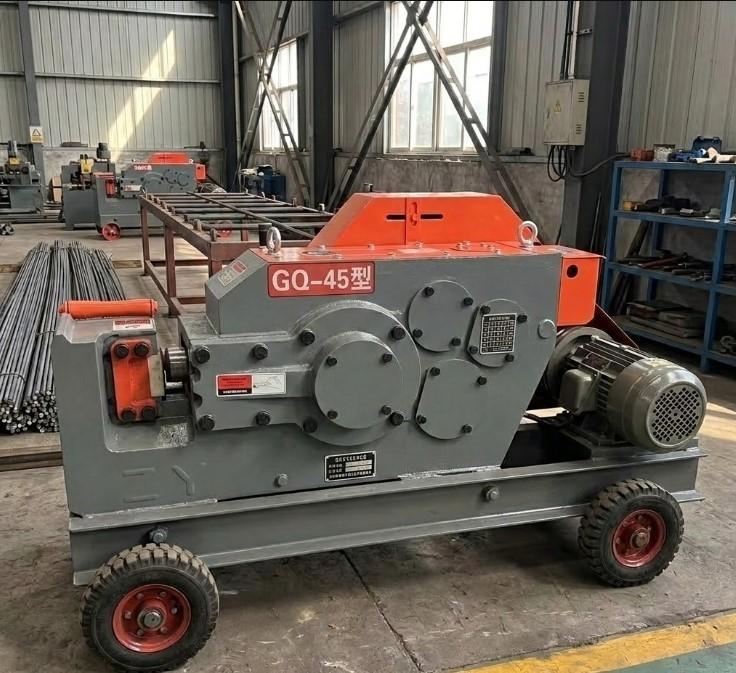
A bar bending machine is primarily used in construction for bending reinforcement bars (rebar).

It helps in:

  • Preparing steel for concrete beams
  • Column reinforcement
  • Foundation structures
  • Infrastructure development

Due to continuous construction growth, bar bending machines are essential equipment on most UAE job sites.

What Materials Can Be Bent Using a Bending Machine?

Bending machines can process various metals, including:

  • Mild steel
  • Stainless steel
  • Structural steel
  • Aluminum
  • Copper
  • Brass

The machine’s tonnage capacity must match the material thickness and tensile strength to avoid cracking or deformation errors.

What Are the Key Applications of Bending Machines in Dubai & UAE?

Construction Industry

The construction sector in Dubai uses bending machines for:

  • Reinforcement bar shaping
  • Steel frame preparation
  • Structural component fabrication

With large infrastructure and commercial projects, precise metal forming is critical.

Oil & Gas Industry

Bending machines are used for:

  • Pipeline fabrication
  • Structural supports
  • Heavy-duty metal components

Industrial operations often follow guidelines from authorities such as UAE Civil Defence to ensure safe equipment operation.

Manufacturing & Fabrication

Fabrication workshops across the UAE use CNC bending machines for:

  • Metal enclosures
  • Machine parts
  • Industrial panels
  • Equipment housings

Compliance with international safety practices referenced by organizations like OSHA and NFPA helps maintain safe production environments.

What Are the Advantages of Using a Bending Machine?

High Precision

CNC-controlled bending ensures accurate angles and consistent output.

Faster Production

Automated systems significantly improve manufacturing speed.

Reduced Material Waste

Precise calculations reduce scrap and rework.

Improved Workplace Safety

Modern bending machines reduce manual handling risks.

Scalability

Suitable for both small workshops and large industrial facilities.

Bending Machine vs Manual Bending: What Is the Difference?

FeatureBending MachineManual Bending
AccuracyHigh precisionLow precision
SpeedFast productionSlow
SafetySafer operationHigher risk
OutputConsistentVariable
Industrial UseLarge scaleLimited

Industrial sectors in Dubai and across the UAE prefer automated bending solutions due to efficiency and safety standards.

How to Choose the Right Bending Machine?

Before selecting a bending machine, consider:

  • Type of material
  • Thickness of metal
  • Required bending angle
  • Daily production volume
  • Automation needs (Manual, Hydraulic, CNC)
  • Budget and maintenance requirements

For heavy-duty UAE industrial projects, hydraulic or CNC machines are typically recommended due to durability and performance.

AI Overview

Learn what a bending machine is, its types, working methods, and industrial uses in Dubai and UAE. Explore how these machines enhance metal shaping, precision, and productivity in fabrication.

FAQs

Can a bending machine bend thick steel plates?

Yes, heavy-duty hydraulic and CNC bending machines can bend thick structural steel plates depending on tonnage. UAE industrial workshops use these machines for large-scale fabrication.

What is the difference between a press brake and a rolling machine?

A press brake bends metal at fixed angles using a punch and die, while a rolling machine forms cylindrical or curved shapes using rollers. Both are used in UAE manufacturing and construction projects.

Is CNC bending better than manual bending?

Yes, CNC bending machines provide higher accuracy, repeatability, and efficiency. They are ideal for industrial-scale production in Dubai fabrication and manufacturing industries.

Are bending machines necessary for construction projects in Dubai?

Yes, bar bending machines are essential on construction sites in Dubai and across the UAE for shaping reinforcement bars used in beams, columns, and foundations.

What types of bending machines are commonly used in UAE industries?

UAE industries commonly use press brakes, pipe bending machines, plate rollers, and CNC systems to meet metal fabrication needs in construction, oil & gas, and manufacturing sectors.

Conclusion

In conclusion, a bending machine is a vital industrial metal forming solution used to bend sheets, pipes, plates, and reinforcement bars with precision, efficiency, and safety. With a range of types including press brakes, pipe bending machines, plate rollers, and CNC systems, these machines are essential for construction, manufacturing, oil & gas, and infrastructure projects across Dubai and the UAE.

For industrial operators, contractors, and machinery owners, Al Yaqeen Hardware provides a complete selection of certified bending machines and metal fabrication equipment designed to meet local industrial demands. 

Contact our industrial experts to secure high-performance machinery engineered for durability, regulatory compliance, and peak operational productivity.

 Top 5 Steel Bending Machines for Construction

electric-vs-manual-hoists-which-one-is-more-efficient

Electric vs Manual Hoists: Which Is Safer & More Efficient?

When it comes to lifting heavy loads in industrial settings, choosing the right hoist can make a substantial difference in efficiency, safety, and operational costs. Both electric hoists and manual hoists serve the same fundamental purpose, but their design, capabilities, and ideal applications vary significantly. 

Understanding these differences is essential for warehouse managers, construction supervisors, and industrial procurement specialists aiming for optimized workflow and safer job sites.

What Is an Electric Hoist?

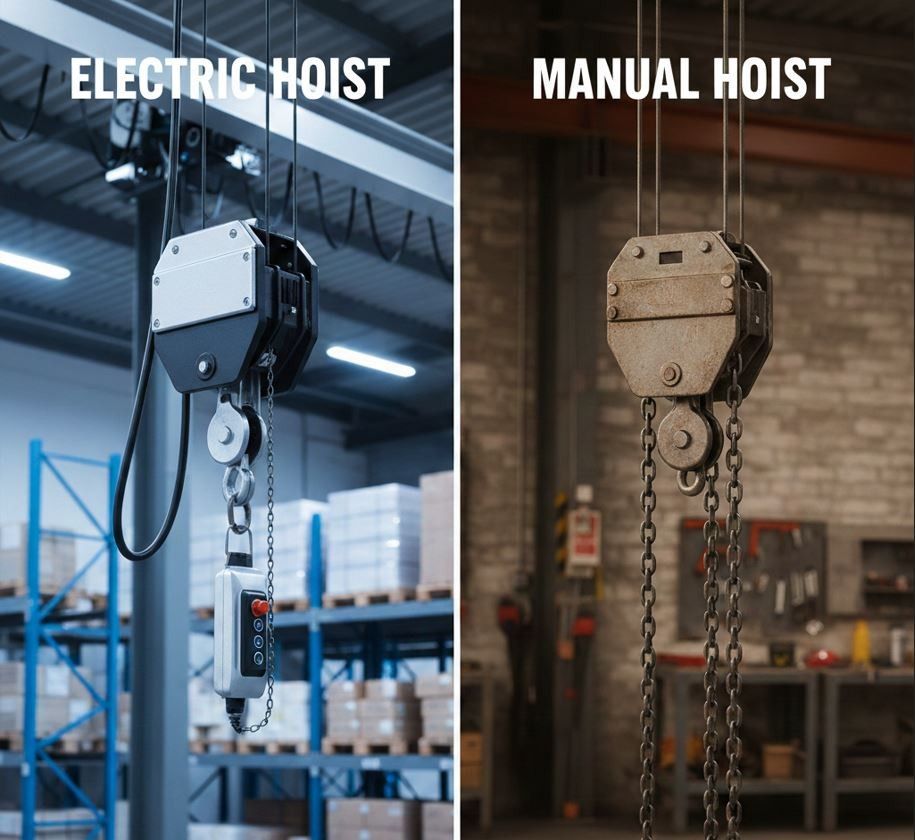
An electric hoist uses a motorized mechanism powered by AC or DC current to lift and lower loads with the push of a button. Operators control it via a pendant or wireless remote, delivering consistent lifting speeds regardless of load weight or shift duration.

Modern electric hoists come in chain or wire rope configurations and often include Variable Frequency Drives (VFD) for smooth, precise load control. If you are sourcing reliable units for your facility, browse our full range of lifting equipment to find the right specification for your operation.

What Is a Manual Hoist?

A manual chain hoist relies entirely on human effort. The operator pulls a hand chain that drives a gear system to lift the load. Lever hoists work similarly, using a ratchet mechanism that allows one-handed operation and angled pulling.

Manual hoists require no power source, making them ideal for remote sites, confined spaces, and emergency applications. Their simple mechanical design means low upfront cost, easy maintenance, and wide parts availability anywhere in the world.

Safety Comparison: Electric vs Manual

Automated Safety in Electric Hoists

Electric hoists with overload protection are equipped with load limiters, electromagnetic brakes, and upper/lower limit switches that trigger automatically when safe thresholds are exceeded. This layered safety architecture removes reliance on real-time human judgment during critical lifting moments.

In high-volume warehouse or plant environments, these safeguards significantly reduce the risk of dropped loads, chain failure, and operator injury. Brands like Novawinch engineer their electric winch systems specifically for these demanding, high-frequency industrial environments.

Operator-Dependent Safety in Manual Hoists

Manual hoists are safe tools but only when used correctly, within rated capacity, by a trained and physically capable operator. Fatigue, distraction, and improper rigging are the leading risk factors, none of which can be mechanically controlled.

That said, manual hoists do feature mechanical load brakes that hold a suspended load when chain tension is released. For occasional, low-weight lifts with trained personnel, they remain a proven and compliant industrial lifting solution.

Efficiency and Productivity

Speed and Throughput

Lifting speed is a direct output variable in any production or logistics environment. A standard electric hoist operates at 8 to 16 feet per minute consistently, shift after shift, while a manual hoist speed depends entirely on the operator and declines with fatigue.

For operations running multiple lift cycles per hour, the cumulative time difference is significant. A unit like the Novawinch 12,000lb heavy-duty electric hoist demonstrates exactly how motorized systems deliver repeatable performance that manual alternatives simply cannot match.

Ergonomics and Workforce Performance

Ergonomic lifting equipment is a measurable factor in reducing injury claims, absenteeism, and workforce turnover. Repeatedly pulling a hand chain across an eight-hour shift causes cumulative shoulder, arm, and back strain that compounds over weeks.

Electric hoists eliminate that physical burden, allowing operators to focus entirely on load control and site awareness. They also reduce dependency on experienced operators, delivering consistent results regardless of who is running the equipment.

Cost: Upfront Price vs Total Ownership Value

Manual hoists have a clear advantage in purchase price. A quality chain block costs a fraction of a comparable electric unit. For low-frequency or backup applications, that upfront saving is entirely justified and financially sound.

Electric hoists deliver lower total cost of ownership over time. Reduced labor hours, fewer injury-related costs, and higher throughput consistently offset the initial investment, especially in operations with daily, high-cycle lifting demands.

Application Fit: Choosing the Right Tool

Where Electric Hoists Perform Best

Electric hoists are the right choice for indoor manufacturing facilities, warehouses, and production lines where overhead crane and hoist systems run through multiple shifts. They excel with stable power supply, high lift frequency, and strict ergonomic or safety compliance requirements.

If your operation handles loads above two tonnes regularly or runs continuous duty cycles, a heavy-duty electric hoist rated H3 or above by HMI standards is the engineered necessity. Contact our experts to match the right specification to your application.

Where Manual Hoists Make Practical Sense

Manual hoists are the practical answer for remote construction sites, marine environments, and confined spaces where electrical supply is unavailable or unsafe. Their portability, corrosion-resistant variants, and zero-power requirement make them irreplaceable in these conditions.

For sites that need reliable pulling and load control without a power source, a hydraulic solution like the hydraulic winch 10,000lb offers a capable middle ground between manual effort and full electric operation. Portable lifting equipment like this keeps your team productive wherever the job takes them.

Maintenance Requirements

Electric Hoist Maintenance

Electric hoist maintenance covers motor insulation checks, brake system inspection, limit switch testing, control panel integrity, and chain or wire rope wear assessment. Modern units with self-diagnostic systems flag issues early, reducing unplanned downtime significantly.

Maintenance intervals follow ASME B30.16 in North America and EN 14492 in Europe. Explore our Stanley lifting equipment range for certified accessories and rigging tools that keep your hoist system compliant and fully operational year-round.

Manual Hoist Maintenance

Manual hoist upkeep is simpler by design, covering chain elongation checks, load brake testing, hook latch inspection, and gear lubrication as the core requirements. Parts are inexpensive, widely available, and inspections are manageable for qualified in-house technicians.

Both types fall under LOLER compliance requirements where applicable, mandating thorough examination every 6 or 12 months depending on application. Skipping scheduled inspections is where most avoidable lifting incidents originate.

Frequently Asked Questions

Is an electric hoist safer than a manual hoist?

Yes, electric hoists use overload protection, limit switches, and electromagnetic brakes to minimize human error. Manual hoists are safe only if operated correctly and within rated limits

What load capacity can a manual hoist handle?

Quality manual chain hoists are rated up to 20 tonnes WLL, sufficient for many industrial applications. For sustained high-capacity lifting, electric hoists provide more consistent and sound performance.

How do I select the right hoist for my site?

Assess maximum load weight, lift frequency, power availability, and environmental conditions before specifying equipment.  Add a 20% safety margin and ensure electric hoist duty cycles match actual usage patterns.

What does duty cycle mean for electric hoists?

The duty cycle (H1–H5 per HMI standards) indicates how often an electric hoist can operate safely within a set period. Choosing a hoist with the correct duty cycle prevents overheating and ensures reliable performance.

Key Takeaways

Choosing between electric hoists and manual hoists depends on load requirements, operational frequency, safety needs, and budget. While manual hoists offer portability and low cost for light-duty lifting, electric hoists excel in safety, efficiency, and high-capacity operations.

Your Lifting Partner for Every Load, Every Site

From lifting machinery to material handling in industrial facilities, investing in the right hoisting equipment enhances operational efficiency and workplace safety. For reliable solutions tailored to your lifting needs, trust Al Yaqeen Hardware.

Contact our hoisting specialists to ensure the safest, most efficient solution for your site needs.

Expand Your Knowledge: Related Industry Guides

Lifting Equipment in Construction Types and Uses for UAE Projects

Lifting equipment in construction decides whether a high-rise stays on schedule or loses weeks to a damaged sling or a mis-rated shackle. Every lift involves a machine, rigging hardware, and a load that is rarely as simple as the drawing suggests.

This guide covers lifting equipment in construction types and uses, from cranes to below-the-hook gear, and explains WLL, MBL, and sling-angle mechanics. It also shows what Gulf heat, sand, and coastal salt do to wire rope, webbing, and hoist brakes, and closes with inspection steps for Dubai and GCC sites.

Table of Contents

What Counts as Lifting Equipment on a UAE Construction Site?

Lifting equipment on a construction site is any machine, accessory, or component that raises, lowers, or suspends a load, including cranes, hoists, winches, slings, shackles, and hooks. Regulators split it into lifting machinery and lifting accessories, and each category carries its own inspection and certification duty.

The split matters for procurement. Lifting machinery, such as cranes and hoists, is bought, registered, and examined as a machine. Lifting accessories, such as slings and shackles, are bought in batches, traced by serial number, and examined on a separate cycle.

Specifiers sourcing construction lifting equipment in Dubai and the wider UAE should treat both groups as one controlled system. Our earlier primer on lifting equipment in construction types and uses covers the basics, and this guide adds the load mechanics, rigging logic, and Gulf site factors that engineers need before signing a lift plan.

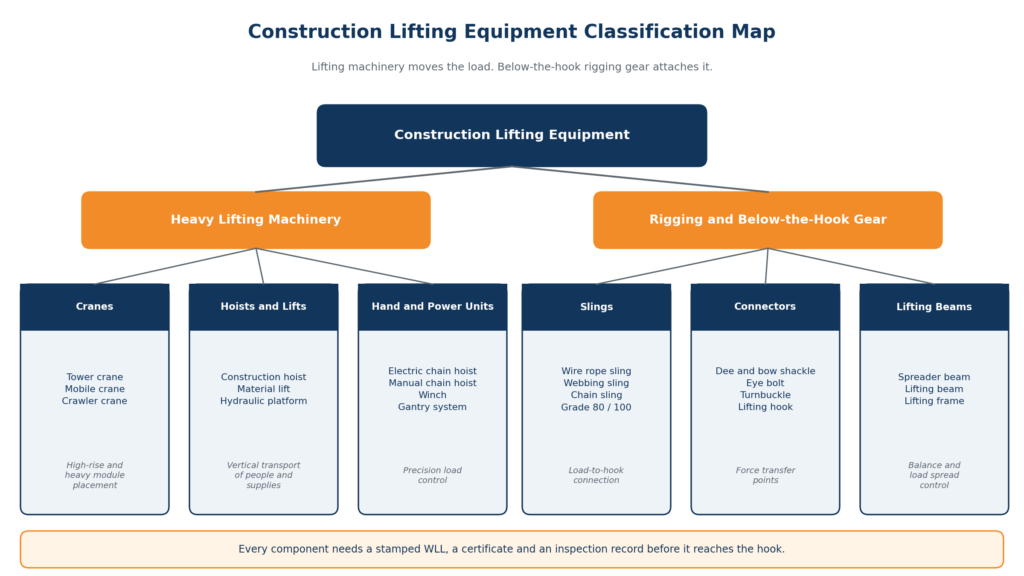
Classification chart of construction lifting machinery and rigging gear used on UAE building sites

Which Heavy Lifting Machines Do UAE Construction Projects Use?

Most UAE projects combine tower cranes for high-rise placement, mobile and crawler cranes for heavy modules, construction hoists for vertical movement of people and supplies, and chain hoists, winches, and gantries for precision control. Selection depends on lift height, working radius, load weight, ground conditions, and site access.

No single machine covers every lift. A high-rise in Dubai Marina, a viaduct in Abu Dhabi, and a plant shutdown in an industrial zone each demand different reach, capacity, and duty cycles. The table gives indicative ranges for planning.

Lifting equipment type Typical capacity range Typical construction application
Tower crane 4 to 25 t maximum, 1 to 4 t at jib tip on mid-size units High-rise material placement, formwork, rebar, precast panels
Mobile and crawler crane 30 to 750 t class, larger units exist Heavy modules, steel erection, plant installation, tower crane assembly
Construction hoist (rack and pinion) 1,000 to 3,200 kg per cage Workforce and material transport on multi-story jobsites
Material lift or mast hoist 500 to 2,000 kg Blocks, boards, and fit-out supplies
Electric chain hoist 0.25 to 50 t Steel alignment, plant setting, workshop handling
Manual chain hoist 0.5 to 50 t Light positioning, maintenance, sites without power
Winch (electric or hydraulic) 1 to 20 t line pull Controlled pulling and positioning
Overhead or portable gantry 1 to 20 t Workshops, precast yards, plant rooms

Capacities are indicative. Always confirm against the manufacturer’s load chart and data plate.

How Do Tower Cranes and Mobile Cranes Differ?

Tower cranes are fixed to a foundation or the structure and lift materials to great heights with long reach, while mobile and crawler cranes travel across the site and set up quickly for heavy, short-duration picks. Tower cranes suit tall buildings; mobile cranes suit module placement and plant installation.

Tower cranes dominate high-rise work because they stay in place for months and cycle quickly over the building footprint. Their limits are wind exposure, jib interference with neighboring cranes, and a load chart that falls steeply as radius increases.

Mobile and crawler cranes need compacted, tested ground and properly sized outrigger mats or crawler platforms. Ground bearing pressure, not the nameplate capacity, often decides whether a heavy pick can proceed.

What Do Construction Hoists and Material Lifts Do?

Construction hoists carry workers and materials vertically along a mast fixed to the building facade, usually with a rack and pinion drive. Material lifts move supplies only, which frees the passenger hoist and removes crane hook time from routine deliveries such as blocks, boards, and fit-out packs.

Hoist planning starts before the facade closes. Landing gates, mast ties, and anchor points must coordinate with the structure, and cage capacity should reflect the peak fit-out load, not the average delivery. Teams planning tower crane and hoist equipment for Dubai towers should fix landing levels early.

Where Do Chain Hoists, Winches, and Gantries Fit?

Chain hoists, winches, and gantry systems provide controlled, short-range lifting where a crane is excessive or inaccessible. Typical uses include structural steel alignment, plant and pump installation, trench and basement work, and workshop handling, with capacities that usually range from 0.5 to 20 tonnes.

Electric chain hoists give fine hook-speed control for aligning steel beams or setting pumps onto bases. A 10,000 lb hydraulic winch suits controlled pulling and positioning where a crane cannot reach. Powered units also need a site supply plan, so check whether diesel generator sets will feed the temporary circuits.

Selection cues for hoists and winches:

  • Duty class (FEM or ISO M rating) matched to daily operating hours
  • Hook speed, lift height, and number of falls of chain or rope
  • Brake design and thermal capacity for repeated short lifts
  • Ingress protection of IP55 or higher for sandy sites
  • Documented overload protection and limit switches

Which Rigging Hardware and Below-the-Hook Gear Do You Need?

Rigging hardware connects the load to the lifting machine and includes slings, shackles, eye bolts, turnbuckles, hooks, and spreader beams. Each component must carry a stamped working load limit that equals or exceeds the load it sees, because the weakest element sets the capacity of the whole assembly.

A lift is only as strong as the lowest-rated component between the hook and the load. Procurement teams should therefore buy rigging as matched assemblies with traceable certificates, not as loose items sourced from different suppliers.

How Do Wire Rope, Webbing, and Chain Slings Compare?

Wire rope slings resist abrasion and heat, webbing slings protect finished surfaces and flex easily, and Grade 80 or Grade 100 alloy chain slings handle the harshest loads and high temperatures. Choose by load surface, temperature, edge sharpness, and the inspection regime your site can maintain.

Property Wire rope sling Webbing sling Alloy chain sling (Grade 80/100)
Abrasion and cut resistance Good abrasion, fair against nicks Low, cut by sharp edges Excellent
Flexibility Moderate Highest Good but heavy
Typical design factor 5:1 5:1 (ASME), 7:1 (EN 1492-1) 4:1
Heat tolerance Fiber core to about 100°C, steel core higher About 80 to 100°C, fiber dependent High, derate above 200°C
Surface protection Can mark finished surfaces Best Marks finished surfaces
Best use Structural steel, general rigging Precast, facades, painted steel Heavy, sharp-edged, hot loads
Main Gulf risk Corrosion, dried-out lubricant UV and heat degradation, grit Corrosion, link and hook wear

What Is the Difference Between Grade 80 and Grade 100 Chain?

Grade 100 chain carries about 25 percent more working load than Grade 80 chain of the same size, so teams can specify lighter slings for the same lift. Both grades are quenched and tempered alloy steel, but their fittings must match the chain grade, because mixing grades makes the lower-rated component the limit.

Wire rope and chain are the usual picks for hot, abrasive structural steel, while webbing protects finished facades and painted steel. Buyers comparing rigging hardware and slings across the GCC can review the Novawinch winch range and Stanley lifting equipment for rated options.

What Do Shackles, Eye Bolts, Turnbuckles, and Hooks Do?

These connectors transfer force between the sling, the load, and the crane hook. Dee shackles take in-line loads, bow shackles accept multi-leg slings and limited side loading, eye bolts need axial alignment, turnbuckles adjust tension, and latched hooks keep slings seated under load. Always match the component to the direction of pull.

  • Dee shackles suit in-line pulls. Side loading cuts the WLL, so keep the pin seated and secured.
  • Bow shackles accept multiple sling legs. Check the stamped WLL, and keep angular loading within the manufacturer’s limits.
  • Eye bolts must be loaded in the plane of the eye with the shoulder seated. Angular pulls on a regular pattern bolt can cut capacity to about 30 percent at 45 degrees, so check the derating table.
  • Turnbuckles adjust rigging length and tension. Use locking devices and keep the pull in line with the body.
  • Lifting hooks need a working safety latch and the load seated in the bowl, not on the tip. Reject hooks with cracks, twist, or a throat opening that has grown by about 5 percent, or follow the manufacturer’s criteria.

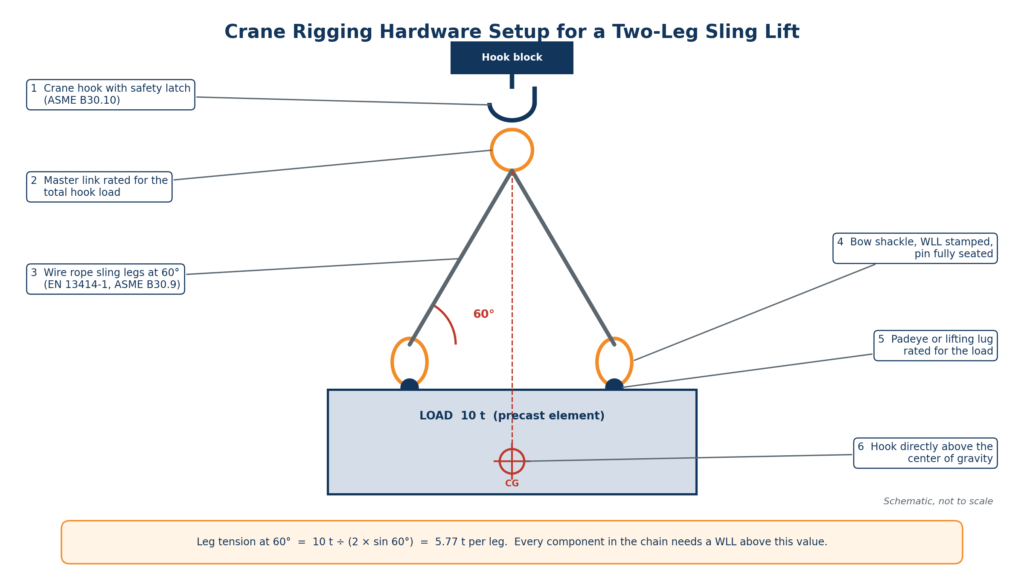
Rigging schematic with crane hook, master link, wire rope sling legs, bow shackles and a 10 t load

Specifying a lifting kit for a new package? Review the certified lifting equipment range and run each assembly through the selection matrix later in this guide before you issue the purchase order.

How Do WLL, MBL, and Safety Factors Work?

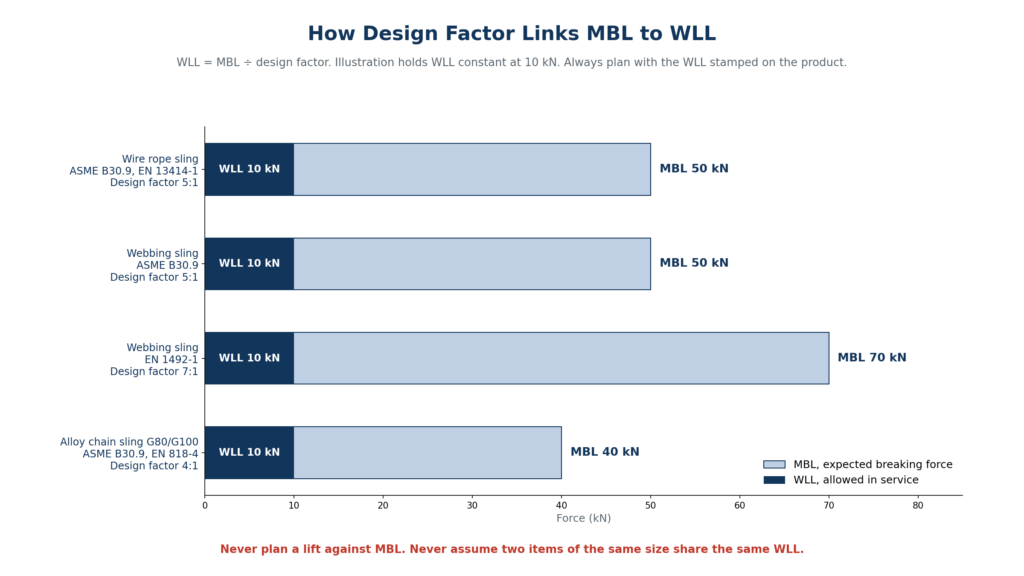
Working Load Limit (WLL) is the maximum load a component may carry in service, while Minimum Breaking Load (MBL) is the force at which it is expected to fail. WLL equals MBL divided by the design factor, so a 5:1 factor means a 50 kN MBL gives a 10 kN WLL.

The design factor is the safety margin built into the rating. Never plan a lift against MBL, and never assume two items of the same size share the same WLL.

Design factors that appear most often:

  • Wire rope slings: 5:1 under ASME B30.9 and EN 13414-1
  • Synthetic webbing slings: 5:1 under ASME B30.9, 7:1 under EN 1492-1
  • Alloy chain slings (Grade 80 and 100): 4:1
  • Shackles and forged fittings: commonly 5:1 or higher, so confirm by marking

Dynamic effects consume part of that margin. Shock loading, snatch lifts, and wind on large panels can multiply the effective load, so planners add allowances rather than relying on the factor to absorb them.

Diagram linking minimum breaking load, design factor and working load limit for lifting slings

How Does Sling Angle Change Tension?

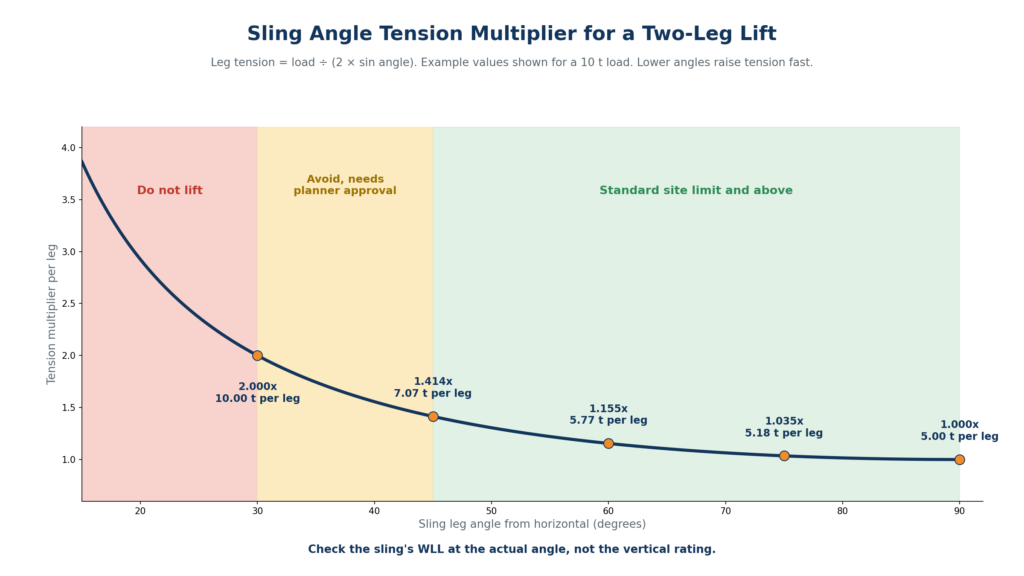
Sling tension rises as the angle between the sling leg and the horizontal falls. For a two-leg sling, each leg carries the load divided by twice the sine of that angle, so a 30 degree angle doubles the tension on each leg relative to a vertical lift.

Angle from horizontal Tension multiplier Leg tension, 10 t load, two legs
90° 1.000 5.00 t
75° 1.035 5.18 t
60° 1.155 5.77 t
45° 1.414 7.07 t
30° 2.000 10.00 t

Each leg’s tension must stay within its WLL at that angle, read from the tag or manufacturer chart. Many sites set 45 degrees as the working minimum, and no lift should go below 30 degrees.

Chart of two-leg sling angle versus tension multiplier from 90 to 30 degrees for lift planning

How Do You Find the Center of Gravity and Distribute the Load?

Position the crane hook directly above the load’s center of gravity, then size and attach the slings so each leg carries a predictable share. If the hook sits off-center, the load tilts until it settles under the hook, which can overload one leg and swing the load toward people.

  1. Get the load weight and center of gravity from the manufacturer or drawings. Never guess for precast or machinery.
  2. Add the weight of slings, shackles, spreader beams, and blocks to the hook load.
  3. Choose lifting points placed symmetrically about the center of gravity.
  4. Set leg lengths and spreader width to keep leg angles at or above 45 degrees.
  5. Check the working radius against the crane load chart, including wind and dynamic allowances.
  6. For rigid loads on three- and four-leg slings, assume two legs carry the full load unless an engineer verifies equal sharing.
  7. Run a trial lift of a few centimeters, pause, and confirm the load is level.

How Do UAE Heat, Sand, and Salt Affect Lifting Gear?

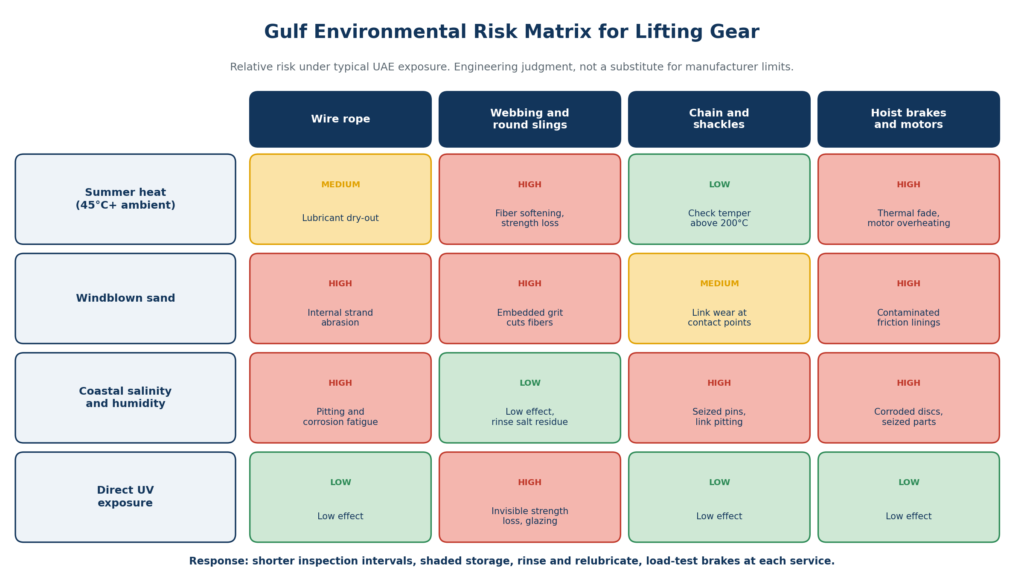
Extreme summer heat degrades lubricants and synthetic fibers, wind-blown sand abrades wire rope and webbing from the inside, and coastal salinity accelerates corrosion on wire, chain, and hoist brakes. These effects shorten inspection intervals and demand tighter storage, cleaning, and replacement criteria than temperate-climate guidance assumes.

Gulf factor Most affected gear Typical failure mode Control
Summer heat (45°C+ ambient) Synthetic slings, rope lubricant, hoist motors Fiber softening, lubricant migration, thermal fade Shaded storage, temperature limits, duty-cycle derating
Windblown sand Wire rope, webbing, chain, hoist gearboxes Internal abrasion, contaminated brakes Clean and relubricate, sleeves, sealed enclosures
Coastal salinity and humidity Wire rope, chain, shackles, brake discs Pitting, corrosion fatigue, seized pins Galvanized or stainless parts, rinse, anti-seize, strict rejection criteria
Direct UV Webbing and round slings Hidden strength loss, glazing UV covers, shaded storage, retire early

Synthetic slings deserve extra attention. Direct sun can push dark steel surfaces well above the temperatures printed on the sling tag, and UV weakens fibers without obvious surface change. Store them in shade, away from chemicals, and retire them early if fibers look glazed or stiff.

Hoist brakes need similar scrutiny. Sand embedded in friction linings reduces holding torque, and salt-laden humidity corrodes discs overnight. Test the brake under a rated load at each service interval, not just with no load.

Matrix of UAE heat, sand and salt effects on wire rope, webbing slings, chain and hoist brakes

Which Standards and Inspections Apply on Dubai Construction Sites?

ASME B30 volumes, EN and BS product standards, and manufacturer manuals define how lifting equipment is designed, rated, and used, while Dubai Municipality and main-contractor requirements govern permits, operator competence, and inspection. Treat third-party examination and a documented daily check as the minimum evidence of control.

No single standard covers an entire lift. Use this reference set, and confirm the edition and any local requirements with the authority and the main contractor:

  • ASME B30 series: B30.3 tower cranes, B30.5 mobile cranes, B30.9 slings, B30.10 hooks, B30.16 overhead hoists, B30.26 rigging hardware
  • EN and BS product standards: EN 13414 wire rope slings, EN 1492 textile slings, EN 818 chain, EN 13889 forged shackles
  • BS 7121: code of practice for safe use of cranes
  • LOLER: UK regulations used as a benchmark for thorough examination periods

Official ASME editions are published through ASME codes and standards, and the HSE guidance on LOLER explains thorough examination in practical terms. Confirm permits and operator requirements with Dubai Municipality and the main contractor.

Check that the certificate of conformity, the test certificate, and the product marking agree on serial number, WLL, and standard. A mismatch means the item is not usable until the supplier resolves it.

What Should a Daily Pre-Use Checklist Include?

A daily pre-use check confirms that the equipment, rigging, and lift area are fit for the planned task before any load is raised. The operator or rigger inspects visible damage, markings, and function, tags defective items out of service, and records the result for the supervisor.

  1. Confirm the inspection tag or color code is current and matches the serial number on the certificate.
  2. Check that the WLL marking is legible on every sling, shackle, and hook.
  3. Inspect wire rope for broken wires, kinks, birdcaging, flattening, and corrosion.
  4. Inspect webbing for cuts, burns, UV glazing, chemical damage, and torn stitching.
  5. Inspect chain for stretch, gouges, bent links, and worn bearing points.
  6. Check hook latches, shackle pins, and eye-bolt seating.
  7. Test limit switches, brakes, and emergency stops without load.
  8. Verify ground conditions, outriggers, exclusion zone, wind speed, and signaller communication.
  9. Tag out defective gear immediately and record it.

When Is Third-Party Inspection Required?

Third-party inspection is required when a competent, independent examiner must certify lifting equipment before first use, after major repair, and at fixed intervals. Common practice follows LOLER-style periods of six months for lifting accessories and twelve months for most lifting machinery, unless the authority, manufacturer, or client specifies shorter periods.

A competent person should also examine gear after any incident, modification, or overload event, and before reuse after storage in extreme conditions. Keep a register that links every sling and shackle to its certificate, inspection date, and next due date.

How Do You Select Lifting Equipment for a Gulf Project?

Select lifting equipment by running every lift through five gates: load and geometry, equipment capacity and reach, rigging configuration, environment and duty cycle, and compliance evidence. A lift passes only when all five gates are documented, because a strong crane cannot compensate for a mis-rated shackle or an expired certificate.

Gate Key question Evidence required
1. Load and geometry What are the true weight, center of gravity, shape, and lift points? Weight certificate, drawings, center of gravity data
2. Machine capacity and reach Does the load chart at working radius exceed the gross load with margin? Load chart, ground bearing check, crane certificate
3. Rigging configuration Does every component’s WLL exceed leg tension at the actual angle? Rigging plan with sling angles, component certificates
4. Environment and duty Do heat, sand, wind, and salt change the rating or the inspection interval? Site condition record, adjusted inspection interval
5. Compliance and competence Are certificates, inspection reports, and operator and rigger cards current? Inspection reports, permits, competence records

Score each gate pass or fail. Any fail stops the lift until the gap is closed and documented.

When you shortlist heavy lifting gear suppliers in the UAE, ask each one to supply the load chart, certificate, and WLL data for gates two and three. For plant that works alongside lifting operations, such as compressors and pumps, see our industrial machinery types and uses guide.

How Should UAE Teams Build a Safer Lifting Program?

Build the program around correct classification, verified WLL data, climate-adjusted inspection, and documented competence. Teams that treat lifting equipment in construction as a controlled system, not a pile of separate products, are better placed to avoid rejected certificates, unplanned stand-downs, and unclear accountability.

Start with a lift register that lists every machine and accessory, its certificate, and its next examination date. Add climate-adjusted inspection intervals, a rule on minimum sling angles, and a clear stop-work authority for riggers.

Use this guide on lifting equipment in construction types and uses as the baseline for your lift plans, then adapt it to each project’s loads and site conditions.

Ready to specify lifting gear with the right ratings and paperwork? Contact the Al Yaqeen Hardware team to discuss specifications, certificates, and delivery for your project.

Frequently Asked Questions About Lifting Equipment in Construction

What are the main types of lifting equipment in construction?

The main types are cranes (tower, mobile, crawler), hoists and material lifts, chain hoists and winches, gantry systems, and lifting accessories such as slings, shackles, hooks, and eye bolts. Machines move the load, while accessories attach it, and both need separate certification.

What is the difference between WLL and MBL?

WLL is the maximum load a rated component may lift in service, and MBL is the force at which a new component is expected to break. WLL is MBL divided by the design factor, and WLL is the only figure planners may use for lift calculations.

How often should lifting equipment be inspected in the UAE?

Inspect lifting equipment before every shift, and arrange formal third-party examination at the interval set by the authority, client, or manufacturer. A LOLER-style approach uses six-month periods for accessories and personnel-lifting equipment and twelve months for other machinery, and heavy heat, sand, or coastal exposure justifies shorter intervals.

how-induction-motor-works-types-uses

How Does an Induction Motor Work, Types and Uses

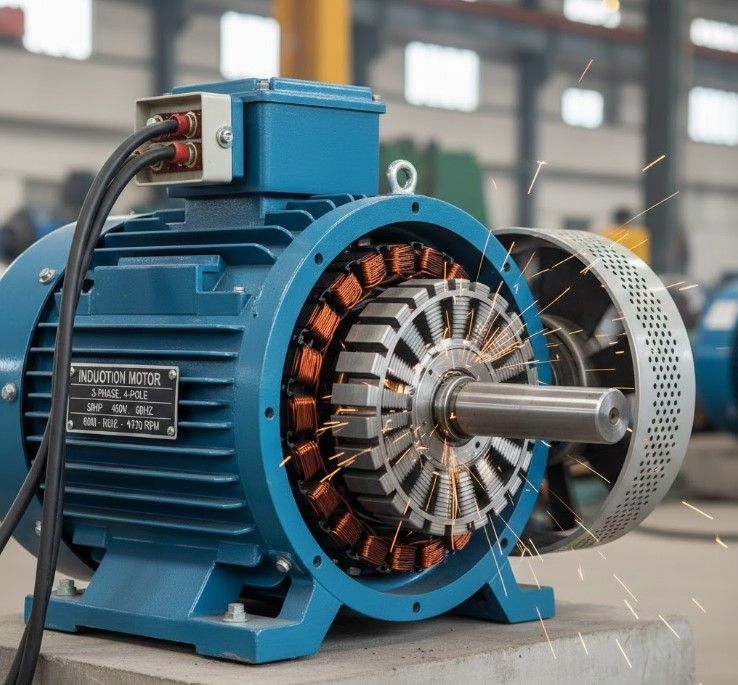
An induction motor is an AC motor where the stator creates a rotating magnetic field that induces current in the rotor, producing torque without brushes or direct electrical contact. It comes in single-phase types for light domestic loads and three-phase types for industrial use, with squirrel cage and wound rotor designs. Simple construction, low maintenance and long service life make induction motors the most widely used motors in homes, commercial buildings and factories.

Induction motors are among the most widely used electric machines in modern electrical and industrial systems. They quietly power everyday equipment such as air conditioners, refrigerators, pumps, compressors, and ventilation units, while also serving as the driving force behind heavy manufacturing machinery and automated production lines. 

Their widespread adoption is mainly due to simple construction, dependable long-term performance, low maintenance requirements, and the ability to operate directly on alternating current power that is readily available in homes, commercial buildings, and industrial facilities.

Understanding how an induction motor works does not require complex mathematics. Once the basic electromagnetic principle and internal structure are clear, it becomes easy to see why these motors dominate real-world applications. 

This article explains the working mechanism, structural design, major types, and practical induction motors uses in a clear and professional manner.

What Is Induction Motor?

An induction motor, also known as an induction machine when referring to the broader electrical machine, is an AC electric motor in which rotation is produced through electromagnetic induction in the rotor. Electrical supply is provided only to the stator windings. The stator creates a rotating magnetic field that induces current in the rotor conductors. 

This induced current produces torque, causing the rotor shaft to rotate and deliver mechanical power to connected equipment. Because the rotor does not require direct electrical contact, induction motors do not use brushes or commutators. 

This reduces mechanical wear, minimizes maintenance, and increases operational reliability, making the motor suitable for continuous duty in demanding environments.

Working Principle of an Induction Motor

When alternating current flows through the stator windings, it generates a magnetic field that rotates at synchronous speed. The rotor is placed inside this rotating magnetic field with a small air gap separating the two components.

As the rotating magnetic field cuts across the rotor conductors, it induces an electric current according to electromagnetic induction laws. The induced current creates another magnetic field within the rotor. Interaction between the stator and rotor magnetic fields produces electromagnetic force, which generates torque and causes continuous rotation of the motor shaft.

The rotor speed never reaches the exact synchronous speed of the magnetic field. The small difference between these speeds is known as slip. Slip is essential for maintaining induced current and sustained torque production inside the motor.

Structure of an Induction Motor

The internal construction of an induction motor mainly includes the stator, rotor, shaft, bearings, cooling system, and protective casing. Laminated silicon steel is used in both stator and rotor cores to reduce energy losses. 

Copper windings in the stator generate the rotating magnetic field, while the rotor converts electromagnetic energy into mechanical motion. 

Two common rotor designs are used in induction motors.

Squirrel Cage Rotor

This is the most widely used rotor type. Conductive bars made of aluminum or copper are short-circuited by end rings, forming a strong and compact structure. Squirrel cage motors are rugged, economical, and require very little maintenance, making them ideal for continuous industrial operation.

Wound Rotor

In this design, three-phase windings are connected to slip rings mounted on the rotor shaft. External resistance can be introduced to improve starting torque and control acceleration. These motors are typically used in heavy-load applications such as cranes, hoists, and elevators.

Types of Induction Motors

An induction type motor is broadly classified according to the electrical supply used for operation, primarily into single-phase and three-phase designs.

Single-Phase Induction Motors

Single-phase motors are commonly used in residential and small commercial environments where only single-phase power is available. Because single-phase supply does not naturally create a rotating magnetic field, auxiliary starting methods such as capacitors or additional windings are required.

These motors are widely found in fans, refrigerators, washing machines, vacuum cleaners, and small water pumps where power demand is relatively low.

Three-Phase Induction Motors

Three-phase induction motors operate using three-phase AC supply, which naturally produces a strong rotating magnetic field. This enables self-starting capability, higher efficiency, smoother torque, and reliable continuous performance.

For this reason, three-phase motors are extensively used in conveyors, compressors, mixers, ventilation systems, machine tools, and automated manufacturing equipment.

Comparison of Three-Phase and Single-Phase Induction Motors

FeatureThree-phase MotorSingle-phase Motor
AC Power SupplyThree-phaseSingle-phase
Starting MethodSelf-startingRequires capacitor or auxiliary winding
EfficiencyHighLower
ConstructionMore complexSimpler
MaintenanceMore difficultEasier
ApplicationsIndustrial and commercial equipmentDomestic and light-load devices

Applications in Daily Life and Industry

The induction motor uses range from household appliances and commercial HVAC systems to pumps, compressors, conveyors, and heavy industrial machinery.

In homes, they provide motion for cooling systems, pumps, and airflow devices. Commercial facilities rely on them for escalators, refrigeration units, and service equipment. 

A major application of induction motor technology is industrial production, where three-phase motors drive conveyors, grinders, mixers, packaging machinery, and ventilation systems. Their durability and efficiency make large-scale manufacturing and automated processing possible.

Advantages of Induction Motors

Induction motors offer several practical advantages. Their design is mechanically simple and robust. Absence of brushes reduces maintenance and increases service life. They operate efficiently for long durations and tolerate dust, vibration, and temperature variations. 

Manufacturing cost is relatively low, allowing use in both small appliances and heavy industrial systems. Modern electronic drives further enhance performance through precise speed control and improved energy efficiency.

Conclusion

Induction motors convert electrical energy into mechanical motion through electromagnetic induction created by alternating current in the stator. Their simple structure, reliability, efficiency, and wide application range make them the most commonly used electric motors worldwide.

From household appliances to heavy industrial machinery, induction motors remain essential to modern engineering and daily life. As technology advances, induction motors continue to become more efficient and versatile, reinforcing their importance in modern electrical engineering.

Browse Al Yaqeen Hardware to explore high-quality induction motors designed for a wide range of applications.

Get the right induction motor for your application

Tell us your load, voltage and phase requirements and our team will help you pick the correct single-phase or three-phase induction motor. You get clear advice on power rating, speed and mounting, with no guesswork and no wrong fit on delivery day.

FAQs

What is an induction motor?

An induction motor is an AC electric motor that produces rotation using a rotating magnetic field and induced current in the rotor.

How does an induction motor works?

It creates a rotating magnetic field in the stator that induces current in the rotor, generating torque and mechanical motion.

Why is slip important in an induction motor?

Slip is the small speed difference between the magnetic field and rotor that allows continuous current induction and torque production.

What are the main types of induction motors?

The two primary types are single-phase induction motors for light loads and three-phase induction motors for industrial applications.

Where are induction motors commonly used?

They are widely used in household appliances, HVAC systems, pumps, conveyors, compressors, and manufacturing machinery.

What are the uses of induction motors?

Induction motors are used in pumps, fans, compressors, conveyor belts, air conditioning systems, and industrial machinery due to their reliability and energy efficiency.

Is an induction motor AC or DC?

An induction motor is an AC (alternating current) motor that converts electrical energy into mechanical energy through electromagnetic induction.

Read More Blogs From Al Yaqeen Hardware

what-is-an-industrial-vacuum-pump-types-and-their-uses

What is an Industrial Vacuum Pump? Types and Their Uses

Industrial vacuum pumps are essential machines designed to remove gas molecules from a sealed volume, creating a vacuum environment for various industrial, laboratory, and manufacturing applications. 

These pumps play a critical role in processes that require controlled pressure, material handling, and precise environmental conditions. 

Understanding their types, applications, and operational standards is vital for buyers, engineers, and facility managers seeking reliable performance and compliance with industry standards.

Understanding Industrial Vacuum Pumps

An industrial vacuum pump is not just a mechanical device; it is a core component in industries ranging from chemical processing to electronics manufacturing. These pumps reduce the pressure in a confined space, enabling processes like degassing, filtration, drying, and packaging. 

The vacuum created influences the efficiency, quality, and safety of operations, making the choice of pump a critical business decision.

Why industrial vacuum pumps matter:

  • Enhanced process efficiency in chemical, pharmaceutical, and food industries
  • Reduced contamination risk by operating in sealed systems
  • Energy savings through optimized vacuum generation
  • Compliance with ISO and ASTM standards for industrial safety

For businesses seeking dependable solutions, exploring leading vacuum pump suppliers ensures access to high-quality pumps, spare parts, and expert technical support, helping maintain smooth operations and maximum efficiency.

How Industrial Vacuum Pumps Work

The vacuum pump working principle depends on the type of pump, but most operate by displacing, compressing, or entrapping gases. The pump’s mechanism, materials, and design determine the achievable vacuum level, pumping speed, and compatibility with gases or liquids.

Key considerations in operation:

  • Oil-lubricated vs. oil-free operation
  • Continuous vs. intermittent use
  • Chemical resistance and temperature tolerance

Understanding the working principle is essential when selecting the correct vacuum pump for specific industrial or laboratory applications.

Types of Industrial Vacuum Pumps

There are various types of vacuum pumps used in industries, each optimized for particular processes. Knowing the vacuum pump types and applications helps buyers and engineers choose the right solution.

1. Rotary Vane Vacuum Pumps

Rotary vane pumps use a rotor with sliding vanes to create a vacuum by displacement. They are widely used for general industrial purposes, such as packaging, laboratory applications, and degassing.

Entities & Features:

  • Typical applications: Chemical processing, printing, food packaging
  • Operational standards: ISO 9001, CE certified
  • Advantages: Compact design, reliable performance, low maintenance

For industries requiring high-performance rotary vane vacuum pumps, trusted brands like Battioni Pagani provide durable, efficient solutions with warranties, spare parts, and technical support, making them ideal for chemical, packaging, and laboratory applications.

2. Diaphragm Vacuum Pumps

These pumps use a flexible diaphragm to move air or gases without direct contact with moving parts. They are ideal for applications requiring oil-free vacuum, such as laboratory, pharmaceutical, or semiconductor operations.

Entities & Features:

  • Oil-free design ensures contamination-free operation
  • Applications: Gas sampling, vacuum filtration, analytical instruments
  • Advantages: Low vibration, chemical resistance, precise control

3. Liquid Ring Vacuum Pumps

Liquid ring pumps operate using a rotating impeller in a sealed liquid, usually water, forming a vacuum through gas compression. They excel in handling wet or corrosive gases, often in chemical and petrochemical plants.

Entities & Features:

  • Ideal for heavy-duty industrial applications
  • Compatible with steam, condensates, and chemical vapors
  • Operational advantage: Continuous operation, minimal wear, corrosion resistance

4. Piston and Plunger Vacuum Pumps

Piston or plunger pumps create a vacuum using reciprocating motion. They are suitable for high vacuum applications requiring precise control over gas removal.

Entities & Features:

  • Applications: Research labs, degassing, vacuum drying
  • Advantages: High vacuum capability, reliable for intermittent use
  • Key considerations: Requires lubrication, regular maintenance

5. Scroll Vacuum Pumps

Scroll pumps use two interleaved spiral scrolls to compress gas and create a vacuum. Their compact, oil-free design makes them suitable for electronics manufacturing and medical device production.

Entities & Features:

  • Applications: Semiconductor, optical coating, vacuum packaging
  • Advantages: Quiet operation, low maintenance, clean vacuum output

How to Choose the Right Industrial Vacuum Pump

Selecting an industrial vacuum pump involves evaluating process requirements, environmental factors, and long-term reliability. Consider these key factors:

  • Vacuum Level Required: Ensure the pump can reach the desired ultimate vacuum, measured in mbar or Torr, to meet your process needs.
  • Pumping Speed: Determines how quickly a vacuum is created for a given volume, affecting overall efficiency.
  • Chemical Compatibility: Confirm that pump materials resist corrosion from gases, vapors, or chemicals handled in your process.
  • Oil vs. Oil-Free Operation: Oil-sealed pumps offer durability for heavy-duty tasks, while oil-free pumps prevent contamination in sensitive applications.
  • Brands and Support: Trusted brands like Battioni Pagani, Busch, and Nash provide warranties, spare parts, and technical assistance.
  • Energy Efficiency: Evaluate power consumption and operational costs for continuous industrial or laboratory use.

Choosing the right pump ensures process reliability, operational efficiency, and reduced downtime, supporting the strategic goals of your production or laboratory setup.

Standards, Warranty, and Maintenance

Compliance with ISO 9001, CE, and ASTM standards ensures safety and performance. Most industrial vacuum pumps come with warranties ranging from 12 to 36 months, depending on the brand and operational intensity.

Regular maintenance, including lubrication, filter replacement, and inspection, prolongs lifespan and maintains efficiency.

Applications Across Industries

Industrial vacuum pumps are used in a wide range of sectors, creating entities and relationships that define modern manufacturing:

  • Chemical & Petrochemical: Degassing, distillation, and solvent recovery
  • Pharmaceutical & Laboratory: Freeze-drying, vacuum filtration, and research experiments
  • Food & Beverage: Packaging, bottling, and dehydration processes
  • Electronics & Semiconductor: Vacuum coating, component assembly, and cleanroom operations
  • Automotive & Machinery: Vacuum forming, brake systems, and material handling

These diverse applications highlight the importance of choosing the right pump type, brand, and maintenance strategy to ensure seamless industrial operations.

FAQs

What is an industrial vacuum pump?

An industrial vacuum pump is a device that removes air or gas molecules from a sealed space to create a controlled vacuum. It is used in laboratories and chemical processing for efficient and safe operations.

What are the types of vacuum pumps used in industries?

Common types include rotary vane, diaphragm (dry), liquid ring, piston/plunger, and scroll vacuum pumps. Each type is designed for specific industrial or laboratory applications.

How does a vacuum pump work?

Vacuum pumps create a vacuum by displacing, compressing, or trapping gas molecules. This reduces pressure inside a system to support processes like drying, filtration, or packaging.

Which vacuum pump is best for laboratory use?

Diaphragm (dry) pumps and rotary vane pumps are preferred for labs due to oil-free operation and contamination-free performance. 

Final Insights 

Choosing the right vacuum pump is essential for ensuring efficiency, reliability, and precision in industrial and laboratory operations. From rotary vane and diaphragm pumps to liquid ring and scroll pumps, selecting a high-quality solution minimizes downtime, supports smooth processes, and meets industry standards.

Exploring trusted suppliers and understanding factors like vacuum level, pumping speed, and chemical compatibility can help you make the best choice for your operations. For businesses in UAE looking for dependable, high-performance vacuum and industrial equipment, I recommend Al Yaqeen Hardware.

With certified pumps, expert technical support, and customized solutions, we help enhance efficiency, minimize downtime, and optimize operations. Contact our vacuum pump consultants to discuss your requirements and find the ideal vacuum pumps for your processes.

informative-guide-to-industrial-machines-types-and-uses

Industrial Machines: An Informative Guide to Types & Uses

Industrial machines form the backbone of modern manufacturing, construction, and material handling. They help businesses increase productivity, ensure precision, and maintain high-quality standards. Understanding the different types of industrial machines and their applications is essential for operators, engineers, and procurement specialists. 

This guide offers a comprehensive overview of industrial machinery, real-world examples, and expert insights to help you make informed decisions.

What Are Industrial Machines?

Industrial machines are specialized equipment designed to perform repetitive, heavy-duty, or complex tasks. Unlike handheld tools, these machines can handle large volumes, provide high accuracy, and often integrate automation or smart sensors.

Examples include CNC machines, welding machines, air compressors, and concrete equipments. Proper selection involves evaluating production volume, operational efficiency, and safety compliance.

Industrial machines are used across multiple sectors, including automotive, aerospace, food processing, construction, and agriculture. Using the right equipment can significantly reduce labor costs while improving consistency and output quality.

Major Types of Industrial Machines

Manufacturing and Production Machines

Manufacturing machines transform raw materials into finished goods with precision. These systems are designed for accuracy, repeatability, and high-volume industrial output.

CNC Machines

CNC machines perform milling, drilling, and turning of metals, plastics, and composites. Automotive and aerospace manufacturers depend on CNC systems for tight tolerances and consistent part quality.

Welding Machines

Welding machines join metal components in construction, shipbuilding, and automotive fabrication. Modern systems support MIG, TIG, and ARC welding to improve strength, reduce defects, and increase production efficiency.

Air Compressors

Air compressors supply pressurized air for pneumatic tools, surface finishing, and industrial automation. Factories and workshops benefit from consistent air supply, and investing in high-capacity air compressors ensures uninterrupted pneumatic tool operation and smoother automation processes.

Selecting the right manufacturing equipment requires understanding material type, production scale, and tolerance requirements. Modern machines often include IoT integration for real-time monitoring and predictive maintenance.

Material Handling and Construction Equipment

Concrete equipments and lifting equipments are key to construction and infrastructure projects.

  • Concrete mixers and batching plants: Provide on-site production of high-quality concrete for residential and commercial buildings.
  • Lifting equipments: Cranes, hoists, and forklifts improve material handling efficiency and reduce manual labor on-site. On busy construction sites and warehouses, investing in certified industrial lifting equipment improves load handling efficiency, minimizes manual risks, and speeds up material movement.
  • Excavators and bulldozers: Essential for earthmoving, foundation digging, and site leveling.

Using construction machinery integrated with smart sensors allows managers to track fuel efficiency, performance, and maintenance schedules. Investing in reliable equipment ensures timely project completion and cost efficiency. 

Power and Fluid Handling Machines

Reliable energy and fluid machines maintain industrial operations without interruptions.

  • Generators: Provide backup power to factories, hospitals, and construction sites, ensuring continuous operations during outages. To avoid costly downtime during power failures, many facilities depend on industrial-grade generators that provide reliable backup power for continuous operations.
  • Diesel operated pumps: Widely used for dewatering, irrigation, and industrial fluid transfer where electricity is limited. For remote sites and emergency drainage needs, durable diesel operated pumps offer dependable water transfer where electrical supply is unavailable.
  • Water pumps: Ensure consistent water supply for industrial plants, agriculture, and municipal projects. Choosing reliable water pumps ensures efficient fluid transfer, pressure stability, and long-term operational reliability.

Modern power and fluid machines often incorporate smart monitoring and energy-efficient designs to reduce operational costs and enhance reliability.

Specialized Industrial Machines

Industrial sectors often require specialized machines to optimize specific operational processes.

  • Vacuum pumps and exhaust blower fans:Used in chemical processing, HVAC systems, and packaging lines to control air flow and remove gases, improving workplace safety and process efficiency.
  • Induction motors and engines: Power conveyor systems, compressors, and heavy-duty production lines where continuous operation and torque stability are essential.

Using specialized industrial machines ensures process consistency, improves product quality, and supports compliance with industry standards. Sourcing equipment from a trusted industrial hardware supplier in Dubai ensures access to certified machines, genuine spare parts, and products suited for demanding industrial environments.

Key Considerations When Choosing Industrial Machines

Application Suitability

When investing in industrial machinery, the first factor to consider is application suitability. Ensure the machine matches your production or operational needs to achieve optimal efficiency and accuracy.

Capacity and Power Requirements

Align the machine’s output with your production scale to prevent underperformance or unnecessary energy consumption. Choosing the right capacity ensures smooth operations and reduces operational costs.

Maintenance and Support

Maintenance and support are crucial for long-term reliability. Check for spare part availability and ease of servicing to minimize downtime and ensure continuous operations.

Safety and Compliance

Verify that machines adhere to local and international safety standards. Proper compliance protects your workforce and ensures regulatory requirements are met.

Automation and Technology Integration

Machines equipped with IoT sensors or robotics can enhance efficiency, enable predictive maintenance, and improve overall operational control. Leveraging modern technology helps maximize productivity.

Expert Assistance

Requesting a quote from a trusted supplier or consulting with an expert ensures you select the right machine tailored to your facility’s requirements. Professional guidance reduces risk and supports better investment decisions.

Advantages of Using Industrial Machines

Investing in industrial machines delivers multiple benefits for any business. Modern equipment increases production speed and efficiency, reduces labor costs through automation, and improves consistency, precision, and overall product quality. These machines also enhance workplace safety and ensure compliance with industry standards.

High-quality industrial machines provide predictable operational costs thanks to energy-efficient designs and reliable performance. They support business scalability, improve operational reliability, and contribute to long-term profitability, making them a strategic investment for sustainable growth.

AI Overview

This blog explores industrial machines, their types, uses, and benefits, including welding machines, air compressors, generators, and pumps, helping businesses optimize productivity and efficiency.

FAQs

What are the main types of industrial machines?

Industrial machines include manufacturing, construction, power, material handling, and specialized machines used across industries. These machines improve productivity, precision, and operational efficiency in many sectors.

How do I select the right industrial machine for my facility?

Choose a machine based on your production requirements, capacity, and operational environment to ensure efficiency and reliability.

Are modern industrial machines energy-efficient?

Many machines now feature energy-saving technologies and IoT monitoring, reducing consumption. Energy-efficient designs lower operational costs while maintaining high productivity.

Can industrial machines be automated?

Yes, many manufacturing, packaging, and material handling machines support automation.
Automation increases output, consistency, and reduces labor dependency.

Conclusion

Investing in the right industrial machines is crucial for improving productivity, efficiency, and safety across manufacturing, construction, and industrial operations. Understanding machine types, applications, and key considerations ensures you make informed decisions that enhance output quality and long-term reliability.

For businesses in the UAE seeking reliable industrial machines and equipment solutions, Al Yaqeen Hardware is your trusted partner for high-performance tools, pumps, and machinery that support growth and operational excellence.

Contact our machinery consultants today to discuss your requirements and find the perfect machinery solutions for your operations.

Explore More Industrial Guides & Articles

If you are planning to upgrade or build your workshop or industrial setup, you may also find these guides helpful:

Search for products

Back to Top
Product has been added to your cart
Compare (0)