
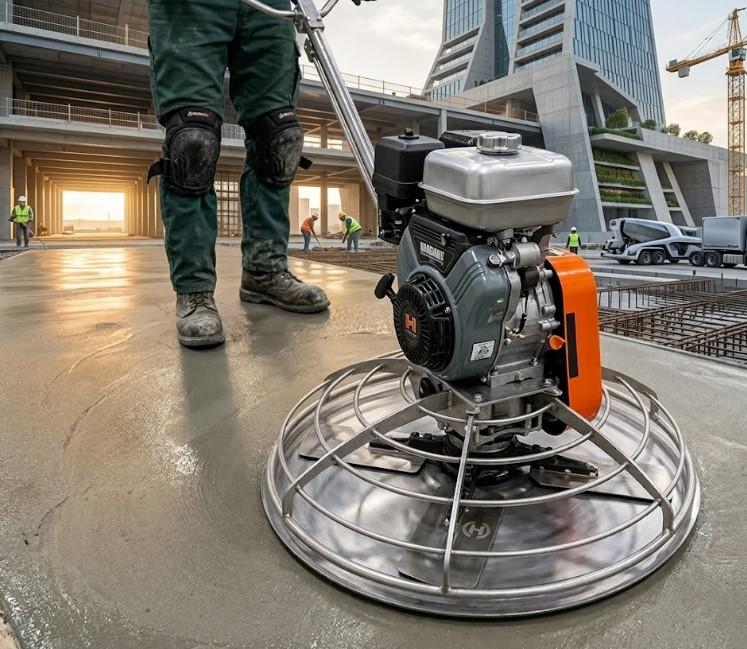
Concrete finishing is a critical step in the construction process. It determines not only the durability and strength of a floor or slab but also its appearance and long‑term performance.
Among the most effective machines used for concrete finishing is the power trowel, a piece of construction equipment that has revolutionized the way concrete surfaces are finished in projects of all sizes.
This guide explains what a power trowel is, how it works, the types available, key applications, professional insights, and regional relevance, highlighting its growing use in UAE construction projects, as well as the practical knowledge a beginner needs to understand this essential tool.
Introduction to Power Trowels
A power trowel is a mechanized concrete finishing machine used to smooth and level concrete surfaces after they have been poured and initially set. In construction terminology it is also referred to as a power float or troweling machine.
The machine consists of rotating blades mounted beneath a powered engine that travels over the concrete surface, pressing and polishing it to achieve a flat, dense finish.
Power trowels are widely used in modern construction projects due to their efficiency and ability to produce consistent surface quality that surpasses traditional hand‑finishing techniques. They are particularly valuable in commercial, industrial, and large residential projects where extensive floor areas require professional finishing.
How a Power Trowel Works
Concrete finishing involves multiple stages beginning with pouring, screeding, floating, and then troweling. The power trowel is used in the later stage after floating, when the concrete has hardened sufficiently to support the machine without being destroyed.
Experts recommend waiting until the concrete surface resists a footprint of approximately 1/8 to 1/4 inch before troweling begins.
Functional Components
A typical power trowel has several key components:
- Engine or Motor: Provides power to the blades and may be gasoline, diesel, or electric powered.
- Gearbox and Spider Assembly: Reduces engine speed and distributes power evenly to the blades for smooth rotation.
- Blades and Float Pans: Blades compress and smooth the surface while float pans are used in early finishing passes to flatten and consolidate concrete.
- Control Handles or Joysticks: Allow the operator to steer and adjust blade pitch for different finishing results.
- Safety Ring: A protective guard surrounding the blades to prevent injury and protect adjacent surfaces.
Operating Principles
During operation the blades spin in a fan‑like pattern across the concrete surface. Operators adjust the blade angle and speed as the concrete hardens. Lower blade angles and slow speeds are used in early stages for flattening while steeper angles and faster speeds are used in later passes for smoothing and burnishing.
Types of Power Trowels
Power trowels are broadly differentiated by how the operator controls them. Each type has advantages depending on project scale and capacity.
Walk‑Behind Power Trowels
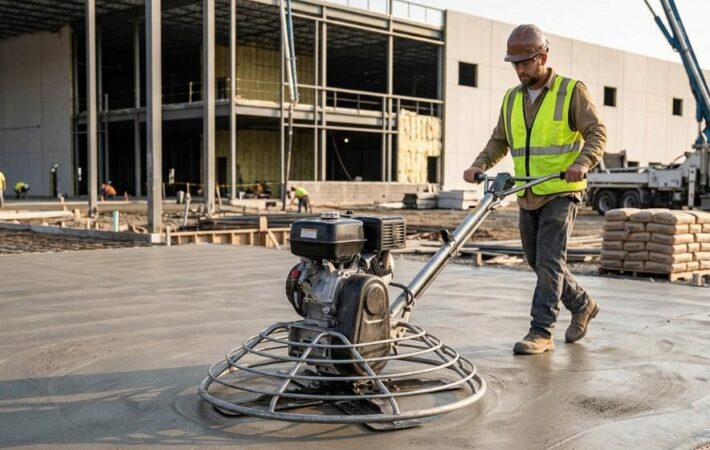
Walk‑behind power trowels are operated from behind the machine by an individual using handles with throttle and pitch control. They are suitable for small to medium concrete slabs such as garage floors, residential slabs, and light commercial projects.
For those seeking a reliable option, the Robin power trowel SM-60 provides excellent performance and durability for everyday construction needs.
Ride‑On Power Trowels
Ride‑on power trowels are larger units with seats and control levers. They are designed for large industrial and commercial floors, high‑traffic spaces, and expansive slabs where coverage area and productivity are critical. Ride‑on models can finish hundreds of square feet per hour and significantly reduce labor time compared to walk‑behind units.
Contractors looking for a high-capacity solution can explore the Robin power trowel SM-100, ideal for extensive UAE construction projects requiring precision and efficiency.
Key Applications of Power Trowels
Power trowels have diverse applications across multiple types of construction. Their efficiency and finishing quality make them indispensable on many job sites.
Commercial and Industrial Flooring
In commercial facilities such as shopping malls, retail centers, warehouses, and production facilities the smooth and durable finish delivered by a power trowel promotes safer working conditions, easier cleaning, and improved long‑term performance of concrete floors.
Infrastructure and Large Surface Projects
Large pavement areas such as airport runways, highway slabs, and transportation terminals demand high flatness and wear resistance. Power trowels contribute to uniform surface finishes that support traffic load and weathering.
Decorative and Polished Concrete
Polished concrete floors are increasingly popular in modern interiors and public spaces due to their reflective surface and durability. Power trowels are essential in the early finishing stages to prepare a uniform surface that will later be polished or treated with coatings.
Power Trowel Usage in UAE Construction Projects
In the UAE, the demand for power trowels has been steadily increasing due to rapid urban development and large-scale infrastructure projects. Commercial towers, airport expansions, logistics hubs, and residential complexes across the country rely on the efficiency and consistent surface finish that power trowels provide. .
Expert Insights and Professional Considerations
Importance of Timing and Technique
Construction experts emphasize that successful power troweling depends on timing. Starting too early can pull up wet concrete and ruin the finish. Waiting too long can result in rough textures and require excessive passes to level. Skilled operators watch moisture and surface resistance to determine the precise moment for troweling.
Blade Management
Choosing the right blade type such as float blades, finishing blades, or combination blades is essential. Professional contractors adjust blades incrementally, from flat to pitched positions, to gradually refine the surface. Overworking the slab can cause delamination or cracking.
Productivity and Labor Savings
Data from industry analysis indicates ride‑on power trowels can cover significantly more area per hour compared to walk‑behind units, which improves productivity and reduces project timelines. These efficiencies are highly beneficial in large projects such as those commonly found in the UAE construction sector.
Safety and Best Practices
Safety is paramount when using power trowels. Professional builders recommend:
- Wearing proper personal protective equipment such as gloves, boots, eye and ear protection.
- Ensuring ventilation when using gas‑powered units in enclosed spaces.
- Conducting pre‑operation equipment checks and maintenance.
- Avoiding distractions and maintaining control around rotating blades.
Case Example: Large‑Scale Finish in UAE Projects
In major construction projects in the UAE, such as warehouse floor installations exceeding 10,000 square feet, contractors use ride‑on power trowels for efficiency and consistency. Such machines can finish up to several thousand square feet per hour, helping meet tight deadlines and maintain flooring quality essential for high traffic and industrial use.
These machines also accommodate rapid concrete curing conditions typical in warm climates by allowing precise control of finishing stages and blade settings.
AI Overview
This blog covers what a power trowel is, how it works, types, applications, expert tips, and its growing use in UAE construction projects for efficient, durable, and high-quality concrete finishing.
FAQs
What is a power trowel used for?
A power trowel is used to smooth, level, and polish concrete surfaces efficiently, producing durable and professional finishes. It is ideal for commercial, industrial, and large residential projects.
What are the types of power trowels?
There are two main types: walk-behind for small to medium slabs and ride-on for large industrial floors requiring higher efficiency and coverage.
When should I use a power trowel on concrete?
Use a power trowel after the concrete has set enough to support the machine but is still soft enough to smooth without tearing the surface.
How do I maintain a power trowel?
Regularly clean blades, check engine fluids, inspect for wear, and follow manufacturer guidelines to ensure optimal performance and machine longevity.
Conclusion
A power trowel is far more than just a concrete finishing machine; it is the defining tool between an ordinary slab and a surface built to endure decades of heavy use. Whether deployed on compact residential pours or sprawling industrial floor installations, the right troweling equipment transforms raw concrete into a dense, polished, load-bearing foundation.
Mastering its operation, blade selection, and timing unlocks a level of finish quality that no manual method can replicate at scale. As UAE’s construction landscape pushes skyward with towers, logistics corridors, and mega-infrastructure, the demand for precision concrete finishing equipment has never been greater.
For contractors and project managers who refuse to compromise on quality, the power trowel remains the single most impactful tool in the concrete finishing arsenal and Al Yaqeen Hardware is a trusted supplier to meet every project requirement.
Contact concrete finishing equipment experts to discuss your requirements and get professional guidance and support.
Expand Your Knowledge: Related Industry Guides
- Industrial Machines: An Informative Guide to Types and Uses: A practical overview of welding machines, compressors, generators, and pumps powering modern industry.
- Lifting Equipment in Construction: Types and Uses: From cranes to chain hoists, a complete guide to construction lifting equipment types and safe site applications.
- What Is an Industrial Vacuum Pump? Types and Their Uses: Rotary vane, diaphragm, and liquid ring vacuum pumps explained for industrial and laboratory buyers.
- How Does an Induction Motor Work, Types and Uses: Understanding single-phase and three-phase induction motors, their working principles, and real-world applications.
- What Is a Bending Machine? A Guide to Its Types & Uses: Mastering Metal Fabrication with the Right Bending Machine.

Leave a comment
Your email address will not be published. Required fields are marked *