UAE’s one-stop shop for tools, power & hand tools, water, sewage & vacuum pumps, air compressors & generators.
types-of-water-pumps-and-their-uses

Different Types of Water Pumps and Their Uses

Quick answer: Water demand across the UAE keeps rising. Villas add rooftop tanks, farms expand drip irrigation, and construction sites need dewatering around the clock. Behind each setup sits a pump, and the wrong choice means weak pressure, burnt motors, and wasted power.

This guide explains the main types of water pumps and their uses in plain terms. It comes from Al Yaqeen Hardware, a water pump supplier in UAE stocking Ebara, Lowara, Pedrollo, Grundfos, and Goulds units. 

By the end, you will know which pump fits your water source, pressure target, and budget.

What Are the Main Types of Water Pumps?

The main types of water pumps are centrifugal, submersible, self-priming, multistage booster, positive displacement, and diesel-driven pumps. Each type moves water differently, so the right choice depends on source depth, required pressure, flow rate, and the liquid being pumped.

Engineers group pumps into two families. Rotodynamic pumps, including centrifugal designs, use a spinning impeller to add velocity and pressure. Positive displacement pumps trap a fixed volume of liquid and push it through the discharge. The Hydraulic Institute pump type definitions set the standard nomenclature for both families.

Most homes, farms, and commercial buildings run on rotodynamic designs. Positive displacement units appear where liquids are thick, abrasive, or need precise dosing.

How Do Centrifugal Water Pumps Work?

A centrifugal pump spins an impeller inside a volute casing, throwing water outward to create flow and pressure. It is the most common of all types of water pumps because it delivers steady output, runs quietly, and costs less to maintain than most alternatives.

Water enters at the impeller eye, gains speed, and leaves through the discharge port at higher pressure. Key parts include the impeller, casing, mechanical seal, and motor. Performance depends on Net Positive Suction Head (NPSH), so a pump placed too high above the water level can cavitate and fail early.

Common uses include:

  • Domestic and building water supply
  • HVAC and chilled water circulation
  • Garden, landscape, and farm irrigation
  • Light industrial water transfer
  • Cooling and washing circuits

A single-stage unit such as the Ebara CDX monoblock pump suits transfer and circulation duties where a moderate head is enough. Monoblock designs mount the impeller directly on the motor shaft, which saves space and simplifies alignment.

The trade-off is simple. Centrifugal pumps lose prime when air enters the suction line, and they handle solids poorly.

When Should You Use a Submersible Water Pump?

Use a submersible pump when the water source sits below the pump inlet, such as a borehole, well, sump pit, or flooded excavation. The sealed motor operates underwater, so the pump pushes water upward instead of pulling it. This removes suction limits and reduces noise.

Submersible pumps come in several variants:

  • Borehole pumps lift clean water from deep wells for supply and irrigation.
  • Drainage and dewatering pumps clear flooded basements, trenches, and construction pits.
  • Sewage and solids-handling pumps use vortex or channel impellers to pass debris.

Match the impeller to the liquid. A clean-water impeller clogs quickly in sandy or muddy water. Check the maximum solids size on the datasheet before buying.

Cable entry sealing and motor cooling are the usual weak points. Never let a submersible run dry, and install a level switch or dry-run protection device.

What Is a Self-Priming Pump and When Is It Better?

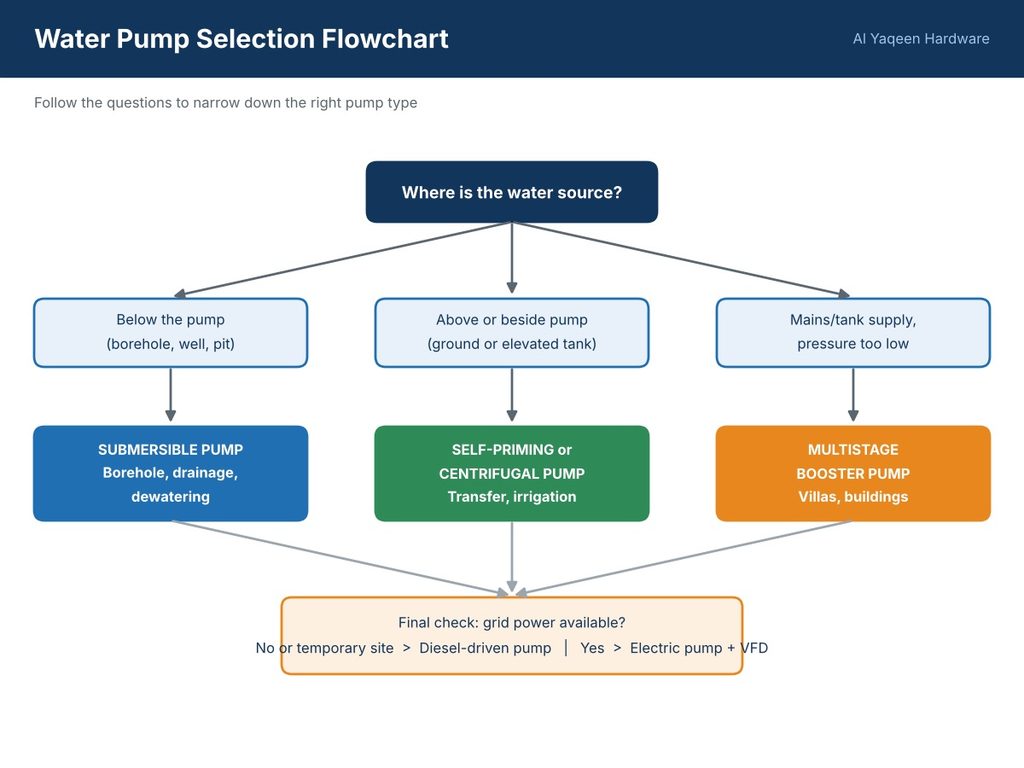
A self-priming pump removes air from its suction line and starts pumping without manual filling. It works well for surface installations where the water level sits below the pump, such as ground tanks, trenches, and canal intake lines, and it restarts reliably after air enters.

This is the core of the self priming pump vs centrifugal pump decision. A standard centrifugal pump needs flooded suction or a foot valve. A self-priming unit holds water in a priming chamber and recovers on its own.

The Ebara JEU self-priming pump is a practical example for garden use, tank transfer, and small irrigation lines. Expect two limits. Efficiency is slightly lower than a comparable centrifugal pump, and suction lift is still capped by physics, typically under 8 metres at sea level.

Which Pump Is Best for Boosting Water Pressure?

A vertical multistage booster pump is best for raising pressure in villas, towers, and commercial buildings. It stacks several impellers in series, and each stage adds a head. This delivers high pressure in a compact footprint with lower energy use than a single-stage pump at the same duty.

The Lowara 5SV vertical multistage pump belongs to this class. Vertical multistage pumps are common in pressure boosting, water treatment, and washing systems.

A complete booster set usually includes:

  • A pressure tank to reduce pump cycling
  • A pressure switch or variable frequency drive (VFD)
  • A non-return valve on the discharge line
  • Dry-run and overload protection

A VFD matches motor speed to demand, which cuts start-stop cycles and electricity use. For buildings with fluctuating demand, it is usually the better long-term investment.

Pump selection guide: Not sure which pump class fits your site? Browse our full range of water pumps in UAE and compare brands, series, and duty ranges before you decide.

Are Diesel and Positive Displacement Pumps Worth Considering?

Yes, when power supply, liquid type, or flow control rules out a standard electric centrifugal pump. Diesel engine-driven pumps serve remote sites, construction dewatering, and fire-fighting duty, while positive displacement pumps handle viscous liquids and dosing. 

Both cost more to operate, so use them only where the application demands it. Diesel-driven pumps offer:

  • Independence from grid power
  • High flow for dewatering and flood control
  • Portability across temporary sites

Their costs are fuel, noise, exhaust, and scheduled engine servicing.

Positive displacement pumps, such as diaphragm, gear, and piston types, deliver consistent flow regardless of pressure. They suit chemical dosing, oils, and slurries, but they produce pulsation and need relief valves to prevent over-pressure.

How Do You Choose the Right Water Pump?

Choose a water pump by matching five parameters: water source, flow rate, total dynamic head, liquid quality, and power availability. Calculate these first, then compare manufacturer pump curves. Skipping this step is the most common reason buyers end up with undersized or oversized pumps.

Use this checklist:

  1. Water source: surface tank, borehole, well, or mains supply.
  2. Flow rate: required volume in m³/h or litres per minute.
  3. Total dynamic head: static lift plus pipe friction loss plus required discharge pressure.
  4. Liquid quality: clean, sandy, salty, hot, or solids-laden water.
  5. Power supply: single-phase, three-phase, or diesel engine.
  6. Duty cycle: intermittent household use or continuous industrial running.

Here is a quick comparison of the main types of water pumps:

Pump Type Best For Main Limitation
Centrifugal Supply, circulation, irrigation Needs flooded suction; poor with solids
Submersible Boreholes, sumps, dewatering Harder to inspect; dry-run risk
Self-priming Surface tanks, trenches, small irrigation Lower efficiency; limited suction lift
Multistage Booster Pressure boosting in buildings Higher upfront cost; clean water only
Diesel-driven Remote or temporary sites Fuel, noise, servicing
Positive Displacement Viscous liquids, dosing Pulsation; slower flow

What Causes Water Pumps to Fail in UAE Conditions?

Most pump failures in UAE trace back to dry running, sand and silt ingestion, overheating, and poor suction piping. High ambient temperatures and hard or saline water accelerate seal wear and scaling, so installation quality matters as much as pump choice.

Preventive controls worth building in:

  • Install dry-run and thermal overload protection
  • Fit strainers or foot valves on suction lines
  • Place pumps in shaded, ventilated enclosures
  • Size suction pipes at or above the pump inlet diameter
  • Inspect seals, bearings, and impellers every year

Treat maintenance as a cost of ownership. A well-chosen pump with a planned service routine outlasts a cheaper unit that runs unprotected.

Which Type of Water Pump Is Worth Choosing?

No single option wins across all types of water pumps. Centrifugal pumps are the practical default for general supply and circulation. Submersible pumps are worth it for deep sources and drainage. Self-priming pumps suit surface tanks, and multistage boosters are the right call for pressure problems.

If you run a household or small farm, start with a centrifugal or self-priming pump. If you manage a building, prioritize a multistage booster with a VFD. For construction or remote work, consider diesel-driven or submersible dewatering units.

The best pump is the one sized to your actual head, flow, and liquid, not the biggest or cheapest on the shelf.

Get the right pump the first time: Share your flow, head, and site details, and our team will recommend a matching model. Contact Al Yaqeen Hardware for sizing advice, brand comparison, and stock availability for your project in Sharjah, UAE.

FAQs

What is the most common type of water pump?

The centrifugal pump is the most common type of water pump. It uses a spinning impeller to move water and suits domestic supply, irrigation, HVAC circulation, and light industrial transfer. Its main limits are priming requirements and poor tolerance of solids.

What is the difference between a submersible pump and a surface pump?

A submersible pump sits underwater and pushes water upward, while a surface pump sits above the water and pulls it in through a suction line. Submersibles suit deep wells and drainage. Surface pumps are easier to inspect and service.

Which water pump is best for home use?

For most homes, a centrifugal or self-priming pump handles tank filling and garden use, while a vertical multistage booster pump fixes low pressure in villas and multi-storey houses. The best choice depends on your water source, required pressure, and daily consumption.
How to Calculate the Right Generator Size for Your Needs

Hot summers, rapid construction and rising cooling demand have made backup power a standard requirement across UAE homes, workshops and warehouses. Yet many buyers still pick a generator by guesswork.

The result is either a unit that trips under load or one that burns fuel at a fraction of its capacity. Knowing how to calculate generator size prevents both outcomes. 

This guide covers the kW and kVA formulas, starting-load multipliers, a worked example and the site conditions that change the final number. It suits facility managers, contractors and homeowners comparing diesel generators.

What Is Generator Sizing and Why Does It Matter?

Generator sizing is the process of matching a generator’s rated output, in kW or kVA, to the combined running and starting loads of your site. A correct generator size protects connected equipment, keeps fuel use efficient and prevents overload trips.

Undersizing causes voltage dips, shutdowns and stalled motors. Oversizing creates a different problem. Diesel engines running below roughly 30% load can suffer wet stacking, where unburned fuel builds up in the exhaust system.

The target is a unit that runs between 50% and 80% of its rated load during normal operation. Every sizing calculation depends on six inputs:

  • Total running load in kW
  • Largest motor starting load
  • Power factor (usually 0.8)
  • Phase configuration (single-phase 230V or three-phase 400V, 50 Hz)
  • Site derating for heat and altitude
  • Duty rating (standby, prime or continuous)

What Is the Difference Between kW and kVA?

kW measures the real power that does useful work, while kVA measures the apparent power a generator must supply to the site. The two connect through power factor, where kW equals kVA multiplied by power factor, and most diesel generators are rated at 0.8.

Kilowatts show what your equipment consumes. Kilovolt-amperes show what the alternator is built to deliver. Nameplates usually list both, and confusing them is one of the most frequent sizing errors.

Keep these formulas at hand:

  • kW = kVA × 0.8
  • kVA = kW ÷ 0.8
  • kW = horsepower × 0.746
  • Three-phase kVA = (1.732 × volts × amps) ÷ 1,000

How Do You Calculate Generator Size Step by Step?

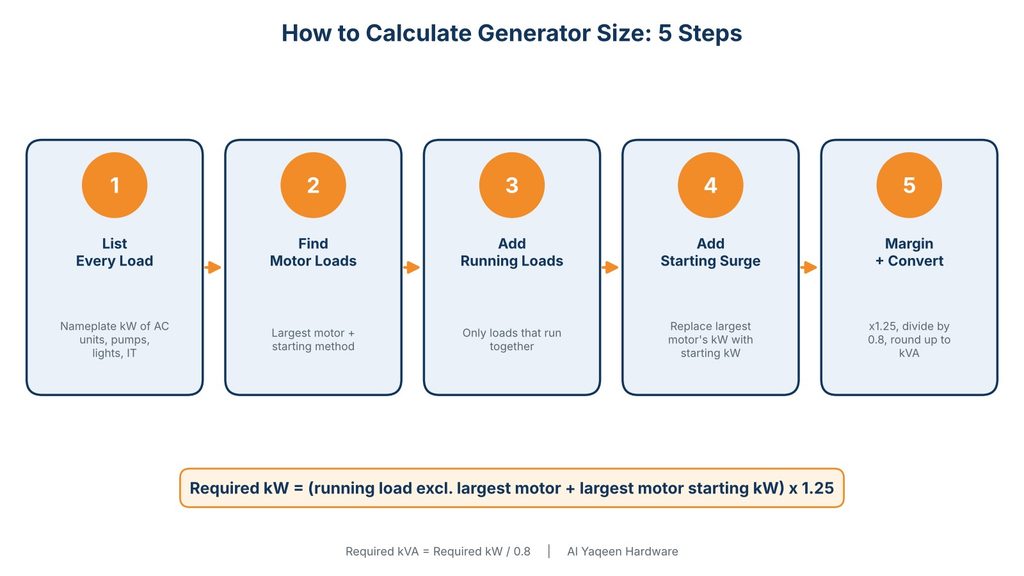
To calculate generator size, list every load, add the running watts, identify the highest starting surge, then apply a safety margin of 20 to 25 percent. Convert the final kW figure to kVA using a 0.8 power factor, then select the next standard generator rating.

  1. List every load. Record the nameplate running power of lights, AC units, pumps, compressors and IT equipment.
  2. Identify motor loads. Note the largest motor and its starting method: direct-on-line, star-delta, soft starter or VFD.
  3. Add simultaneous running loads. Sum only what runs at the same time, not everything installed on site.
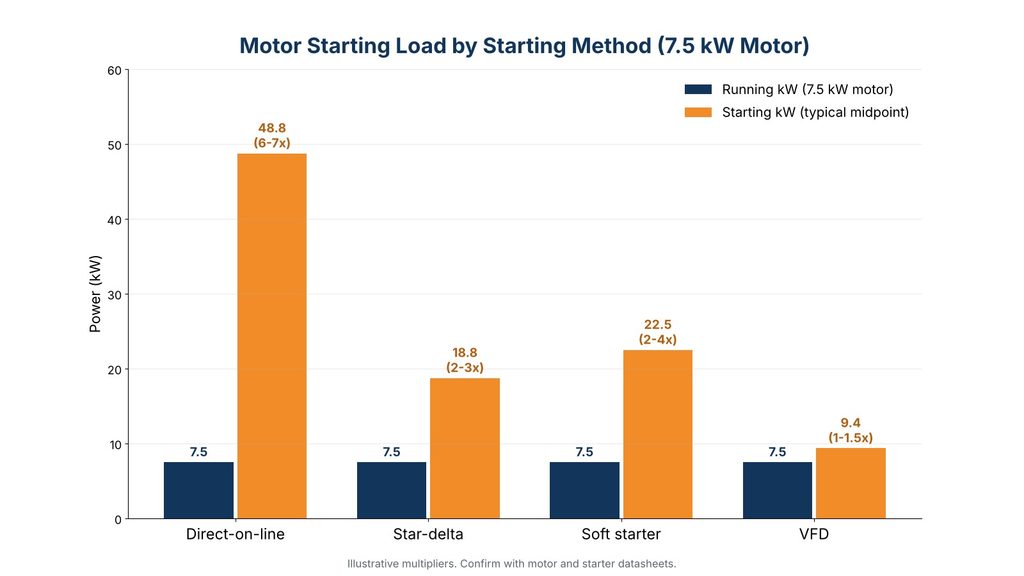
  4. Add the starting surge. Replace the largest motor’s running kW with its starting kW.
  5. Apply margin and convert. Add 20 to 25%, divide by 0.8, then round up to the next standard kVA rating.

The working formula is: Required kW = (running load excluding largest motor + largest motor starting kW) × 1.25

What Does a Worked Generator Size Example Look Like?

A small workshop with 24 kW of running load and a 7.5 kW compressor needs about 61 kVA, which rounds up to a 62.5 kVA generator. The calculation adds the compressor’s starting surge to the remaining running loads, applies a 25% margin, then converts kW to kVA.

This example is illustrative. Always use nameplate values from your own equipment.

LoadRunning kW
Lighting and sockets3.0
Four split AC units (2.0 kW each)8.0
Water pump1.5
Air compressor (largest motor)7.5
Workshop tools4.0
Total running load24.0
  • Running load without the compressor: 24.0 − 7.5 = 16.5 kW
  • Compressor starting load (3× with soft starter): 7.5 × 3 = 22.5 kW
  • Peak demand: 16.5 + 22.5 = 39.0 kW
  • With 25% margin: 39.0 × 1.25 = 48.75 kW
  • Convert to kVA: 48.75 ÷ 0.8 = 60.9 kVA, so select 62.5 kVA

Normal running demand of 24 kW is about 48% of the unit’s 50 kW capacity. That sits comfortably above the wet-stacking threshold.

Why Do Starting Loads Matter More Than Running Loads?

Electric motors draw three to seven times their running current for a fraction of a second at startup. The generator must absorb this surge without a voltage drop that stalls the load or trips protection, so the starting load usually decides the final generator size.

The starting method changes the surge dramatically. Choosing a soft starter or VFD can reduce the required generator capacity.

Starting methodTypical surge multiplier
Direct-on-line6–7×
Star-delta2–3×
Soft starter2–4×
VFD1–1.5×

Sequencing helps too. An automatic transfer switch (ATS) with time-delayed load stepping starts large motors one at a time instead of together.

Want to compare generator options before you decide?

Once you have your kVA figure, explore our range of commercial and industrial diesel generators. Compare power ratings, engine options and enclosure types to find a configuration that matches your load calculation and site requirements.

How Do UAE Site Conditions Change Generator Size?

High ambient heat, dust and humidity reduce the usable output of a generator below its nameplate rating. Manufacturers publish derating curves, so you should add capacity when site temperatures exceed the reference conditions defined in the ISO 8528 standard for generating sets.

ISO 8528-1 rates output at 25°C ambient, 100 kPa pressure and 30% humidity. UAE summer temperatures regularly exceed 45°C, and enclosed plant rooms run hotter still. The ISO standards for generating sets set out the testing and rating framework that manufacturers follow.

Check these factors before finalizing your generator size:

  • Ambient temperature: Request the derating curve at your peak site temperature.
  • Ventilation: Plant rooms need enough airflow for the radiator and combustion air.
  • Altitude: Output falls as air density drops, which matters for elevated sites.
  • Fuel quality: Contaminated diesel causes injector wear and unplanned shutdowns.
  • Non-linear loads: UPS units and VFDs create harmonics and may require a larger alternator.
  • Phase balance: Keep load across phases within about 10% of each other.

Local grid connection and change-over requirements may also apply, such as those set by SEWA in Sharjah. Confirm requirements before installation.

Which Rating Should You Choose: Standby, Prime or Continuous?

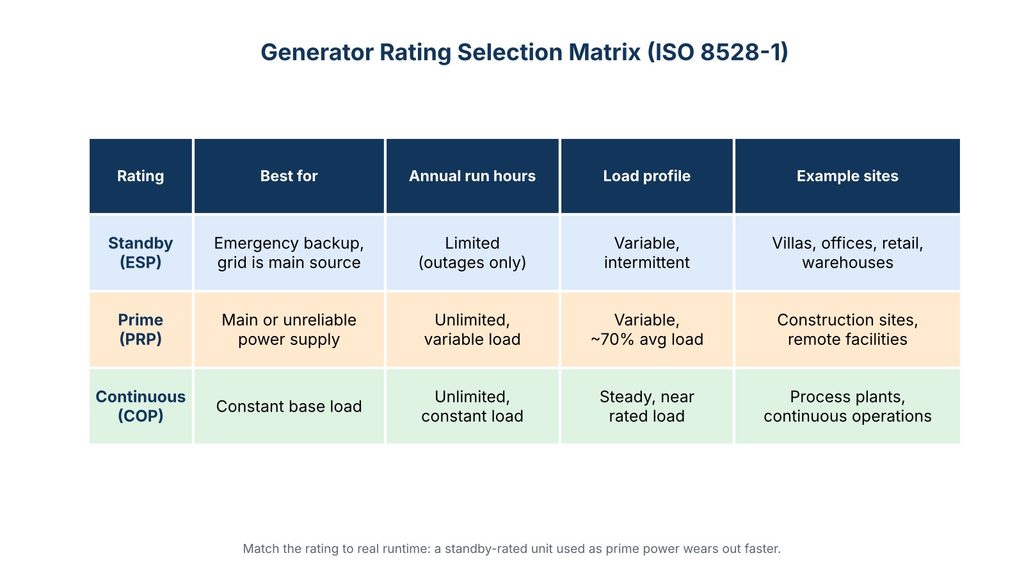
Standby rating suits emergency backup with limited annual running hours, prime rating suits variable loads with unlimited hours, and continuous rating suits constant base loads. Pick the rating that matches your real runtime, because a standby-rated unit used as prime power will wear out faster.

ISO 8528-1 defines these categories as emergency standby power, prime running power and continuous running power. The same physical engine carries different kVA ratings under each.

  • Standby: Homes, offices, retail and buildings with grid power as the main source.
  • Prime: Construction sites, remote facilities and locations with unreliable or no grid supply.
  • Continuous: Process plants and sites that need constant output with little load variation.

Also plan fuel autonomy. At about 75% load, a diesel generator consumes roughly 0.27 litres per kWh, so tank size should match your longest expected outage.

What Are the Most Common Generator Sizing Mistakes?

The most common mistakes are sizing by running watts alone, ignoring motor starting surges, skipping the safety margin and forgetting site derating. Each error leads to overload trips or underloaded engines, so checking all four before purchase protects both equipment and fuel budget.

Use this six-point sizing audit before you approve any quote:

  1. Load list verified against nameplates, not estimates.
  2. Largest motor and its starting method documented.
  3. UPS, VFD and other non-linear loads flagged for alternator sizing.
  4. Phase balance checked across all three phases.
  5. Growth allowance of 15 to 20% added for planned expansion.
  6. Derating curve confirmed at your peak site temperature.

Maintenance matters as well. An annual load bank test confirms the generator delivers its rated output, and regular servicing keeps starting reliability high.

Is It Worth Calculating Generator Size Before You Buy?

Yes, calculating generator size is worth the effort for almost every buyer, because it takes under an hour and prevents costly mistakes. An overloaded unit fails during outages, while an oversized unit wastes fuel and wears the engine every month it runs.

Your intent decides how deep to go. A homeowner with a few AC units and pumps can use a quick load list and the 25% margin rule. A business with large motors, UPS equipment or critical operations should add starting-load analysis and a supplier-led review.

The takeaway is simple. Add up real loads, plan for the largest motor start, adjust for heat, then round up to the next standard rating.

Ready to confirm your generator size?

Share your load list with our team and receive a recommended kVA rating, rating type and configuration for your site. Whether your project is in Sharjah, Dubai or anywhere in UAE, our team can help you choose the right generator with confidence.

FAQs

What size generator do I need for a 3-bedroom villa?

Most villas fall between 25 and 50 kVA, depending on how many AC units, pumps and kitchen appliances run together. Use the load list method in this guide, include the largest motor starting surge, and add a 25% margin for an accurate figure.

How many kW is 100 kVA?

A 100 kVA generator delivers about 80 kW at a standard 0.8 power factor. Use the formula kW = kVA × 0.8. If your loads have a different power factor, check the generator datasheet for exact output.

What happens if a generator is too big or too small?

An undersized generator overloads, trips or fails to start motors. An oversized generator runs at low load, which can cause wet stacking, higher fuel use and engine wear. Aim for normal operation between 50% and 80% of rated capacity.

Search for products

Back to Top
Product has been added to your cart
Compare (0)