
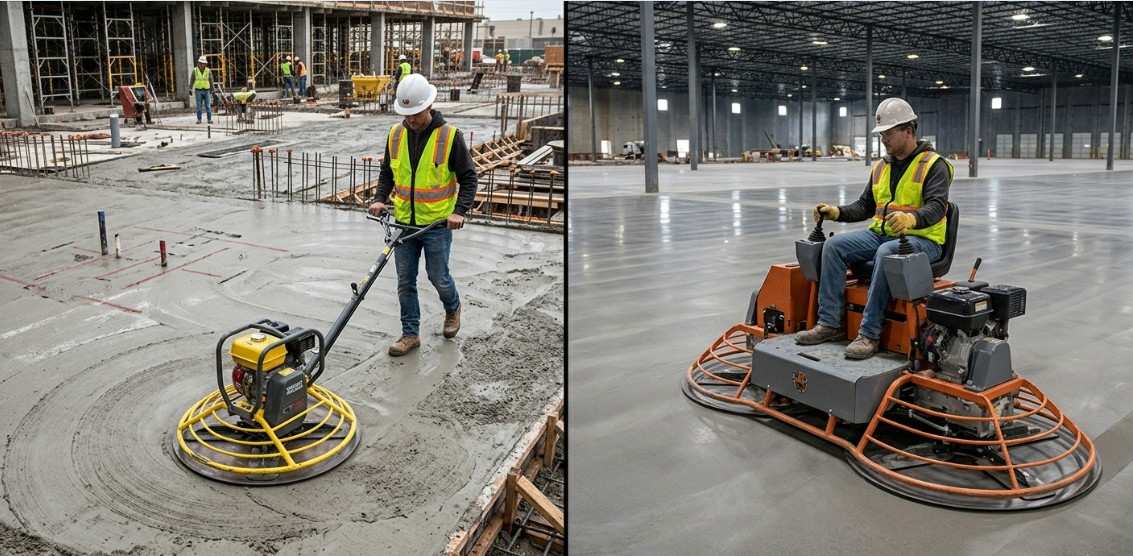
Concrete finishing is a critical stage in construction across the UAE, where large-scale infrastructure, commercial developments, and high-end residential projects demand smooth, durable, and high-performance concrete surfaces. Power trowels play a central role in achieving these finishes by compacting and polishing freshly poured concrete.
Among the available options, walk-behind and ride-on power trowels are the two most widely used machines. Choosing between them significantly impacts productivity, finish quality, labor costs, and project timelines. This guide provides a detailed, professional comparison tailored to UAE construction conditions.
Understanding Power Trowels in UAE Construction
Power trowels, also known as power floats, are machines used to smooth and compact concrete surfaces during the finishing stage. The process involves multiple passes including floating, smoothing, and final finishing to achieve the desired surface hardness and appearance.
For a detailed overview, refer to our power trowel complete guide, which explains the multiple passes including floating, smoothing, and final finishing to achieve the desired surface hardness and appearance.
In the UAE, where high temperatures accelerate concrete setting times, efficient finishing equipment is essential to maintain quality and meet tight construction schedules.
Walk-Behind Power Trowels
Overview and Working Mechanism
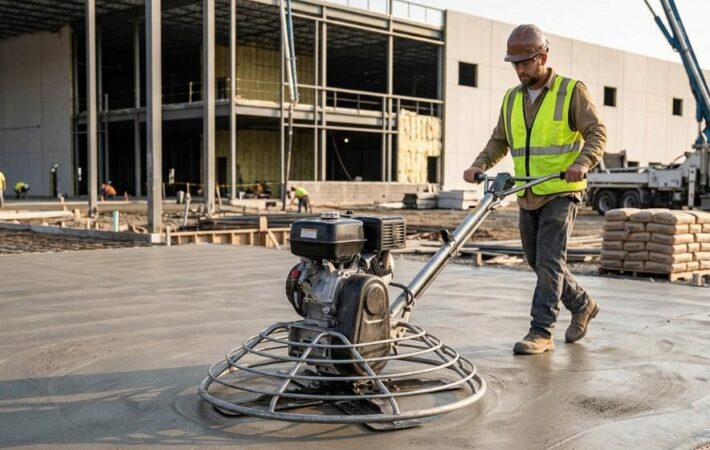
Walk-behind trowels are single-rotor machines operated by a worker walking behind and guiding the equipment. Blade sizes typically range between 24 and 48 inches, making them compact and maneuverable.
Key Advantages
- Cost-Effective Equipment: Walk-behind models have significantly lower upfront costs, making them suitable for small contractors or budget-conscious projects. Consider models like Robin power trowel SM-60 for reliable performance and easy handling on smaller sites.
- Superior Control and Precision: Operators can physically feel the surface, allowing better control during finishing passes, especially in complex layouts.
- Ideal for Tight Spaces: These machines can work close to walls, columns, and edges where larger machines cannot reach.
- Lower Maintenance Requirements: Simpler mechanical systems reduce maintenance complexity and costs.
Limitations
- Lower Productivity: Walk-behind trowels typically cover smaller areas per hour, making them inefficient for large-scale projects.
- Higher Labor Demand: Large slabs may require multiple operators, increasing workforce costs.
- Operator Fatigue: Continuous manual operation can lead to fatigue, affecting consistency over time.
Typical Applications
- Residential slabs and villas
- Small commercial spaces
- Areas with obstacles or confined layouts
- Edge finishing in large projects
Ride-On Power Trowels
Overview and Working Mechanism
Ride-on trowels are dual-rotor machines operated by a seated driver. These machines feature wider blade spans, higher horsepower, and advanced control systems, enabling them to cover large areas efficiently.
Key Advantages
- High Productivity and Speed: Ride-on trowels can be up to four to five times faster than walk-behind models. For large-scale UAE projects, the Robin power trowel SM-100 delivers superior efficiency and consistent finishing results.
- Large Area Coverage: Capable of finishing up to 10,000 square feet per hour depending on conditions.
- Reduced Labor Costs: One operator can perform the work of multiple workers, significantly lowering manpower requirements.
- Consistent Surface Quality: Dual rotors apply uniform pressure, producing smoother and more durable finishes.
- Enhanced Operator Comfort and Safety: Seated operation reduces fatigue and includes safety features such as emergency shut-off systems.
Limitations
- Higher Initial Investment: Ride-on machines are considerably more expensive than walk-behind units.
- Limited Maneuverability: Not suitable for tight or obstructed areas.
- Requires Skilled Operators: Proper training is necessary to achieve optimal results.
- Higher Maintenance Complexity: Advanced systems increase maintenance requirements.
Typical Applications
- Industrial warehouses
- Airport runways and logistics hubs
- Large commercial floors
- Mega infrastructure projects
Performance Comparison: Walk-Behind vs Ride-On Power Trowels
Productivity and Efficiency
Ride-on power trowels deliver significantly faster completion rates on large slabs, typically improving productivity by 30 to 50 percent. Their dual-rotor design allows wider coverage in a single pass, which is critical for large-scale UAE projects.
A single ride-on machine can effectively replace multiple walk-behind units, reducing the number of operators required on-site. This directly improves operational efficiency while lowering overall labor costs.
Cost Analysis
Walk-behind power trowels are more affordable in terms of initial purchase and day-to-day operating expenses. They are ideal for smaller contractors or projects with limited budgets.
Ride-on trowels require a higher upfront investment, but they offer better long-term return on investment. Reduced labor requirements and faster project completion contribute to overall cost savings.
Finish Quality
Walk-behind trowels provide greater control, making them suitable for detailed finishing and edge work. Operators can closely monitor the surface and make precise adjustments during the finishing process.
Ride-on trowels deliver superior uniformity across large surfaces due to consistent blade pressure and speed. This results in a smoother, denser finish suitable for high-performance flooring applications.
Maneuverability
Walk-behind trowels are highly maneuverable and can easily operate in confined or obstructed areas. They are ideal for working around columns, walls, and tight corners.
Ride-on trowels are designed for open and unobstructed spaces where maximum efficiency can be achieved. Their larger size limits their effectiveness in restricted environments.
Walk-Behind vs Ride-On Power Trowels Comparison Table
| Feature | Walk-Behind Trowel | Ride-On Trowel |
|---|---|---|
| Operation Style | Manual | Seated operator |
| Project Size | Small to medium | Large-scale projects |
| Coverage Rate | 500–3,000 sq ft per hour | 3,000–10,000+ sq ft per hour |
| Maneuverability | Excellent in tight spaces | Limited in confined areas |
| Finish Quality | Moderate | High precision and uniform |
| Operator Fatigue | High | Low |
| Cost | Lower initial cost | Higher investment |
| Training Required | Minimal | Moderate to high |
Ride-on trowels can be up to four to five times faster than walk-behind machines due to higher power and dual rotor systems.
Productivity and Efficiency Breakdown
Real Output Comparison
- Walk-behind: 500 to 1,000 sq ft per hour
- Ride-on: 3,000 to 5,000 sq ft per hour
Ride-on machines can be four to five times faster than walk-behind units
Labor Efficiency
- One ride-on machine can replace up to six walk-behind units in some scenarios
- Single operator vs multiple workers reduces labor costs significantly
Example Scenario
For a 30,000 sq ft warehouse floor:
- Walk-behind approach may require 4 to 6 workers and extended hours
- Ride-on solution can complete the job with 1 to 2 operators within a shorter time frame
This difference is critical in UAE projects where deadlines are strict.
UAE-Specific Considerations
Climate Impact on Concrete Finishing
High temperatures in the UAE accelerate the concrete setting process, reducing the available finishing time. Ride-on trowels help contractors respond to this challenge by covering large areas quickly and maintaining surface quality.
Their speed ensures that finishing operations are completed within optimal time windows, preventing defects such as surface cracking or uneven texture.
Labor Market Dynamics
The UAE construction sector often experiences labor cost pressures due to large-scale developments and workforce demand. Ride-on trowels help reduce reliance on large crews by allowing a single operator to perform extensive finishing work.
This shift supports cost optimization while maintaining productivity and quality standards across projects.
Project Scale Trends
Mega construction projects in the UAE, including logistics hubs and industrial zones, require equipment that can handle expansive concrete surfaces efficiently. Ride-on trowels are increasingly preferred in these environments due to their high output and consistent results.
As project sizes continue to grow, contractors are adopting ride-on solutions to meet tight deadlines and performance expectations.
Expert Perspective
Industry experts emphasize that equipment selection depends on project scale and finish requirements.
- Walk-behind machines provide better tactile control in complex layouts
- Ride-on machines produce denser and flatter surfaces due to higher weight and power
- Combining both machines delivers optimal results on most job sites
Decision Framework
Choose Walk-Behind Trowels If
- Project size is small to medium
- Budget constraints are significant
- Site has tight access or obstacles
- High precision is required in detailed areas
Choose Ride-On Trowels If
- Project involves large slab areas
- Speed and efficiency are critical
- Labor costs need to be minimized
- High-quality, uniform finish is required
AI Overview
This blog explains the key differences between walk-behind and ride-on power trowels for UAE concrete finishing, covering performance, productivity, cost analysis, project suitability, and expert recommendations for optimal results.
FAQs
What is the main difference between walk‑behind and ride‑on power trowels?
Walk‑behind power trowels are manually guided and best for small or tight areas, while ride‑on machines allow a seated operator and are ideal for covering large slabs with higher productivity.
Which power trowel is better for large UAE construction projects?
Ride‑on power trowels are generally preferred for large commercial and industrial floors due to their ability to finish much more area per hour and reduce labor needs.
Can walk‑behind trowels achieve the same finish quality as ride‑on trowels?
Walk‑behind machines give good control near edges and obstacles, but ride‑on trowels typically deliver a more uniform, high‑quality finish on expansive surfaces.
Are ride‑on power trowels more cost‑effective than walk‑behind models?
Although ride‑on trowels have a higher upfront cost, they can be more cost‑effective on frequent large jobs due to lower labor requirements and faster completion rates.
Conclusion
Choosing the right power trowel for UAE concrete finishing depends on project scale, site conditions, and desired finish quality. Walk‑behind trowels are ideal for small spaces, edges, and detailed work, while ride‑on trowels deliver superior efficiency, speed, and uniform finishes for large commercial and industrial slabs. For most projects, a combination of both types ensures maximum productivity and optimal surface quality.
Ready to Optimize Your Concrete Finishing?
Contact Al Yaqeen Hardware today to explore our expert power trowel solutions and elevate your construction projects across Dubai and the UAE. Our team of specialists is ready to provide tailored advice, on-site support, and the best equipment options to meet every project requirement.
Expand Your Knowledge: Related Industry Guides
- Industrial Machines: An Informative Guide to Types and Uses: A practical overview of welding machines, compressors, generators, and pumps powering modern industry.
- Lifting Equipment in Construction: Types and Uses: From cranes to chain hoists, a complete guide to construction lifting equipment types and safe site applications.
- What Is an Industrial Vacuum Pump? Types and Their Uses: Rotary vane, diaphragm, and liquid ring vacuum pumps explained for industrial and laboratory buyers.
- What Is a Bending Machine? A Guide to Its Types & Uses: Mastering Metal Fabrication with the Right Bending Machine.
- How Does an Induction Motor Work, Types and Uses: Understanding single-phase and three-phase induction motors, their working principles, and real-world applications.

Leave a comment
Your email address will not be published. Required fields are marked *