
Lifting equipment in construction decides whether a high-rise stays on schedule or loses weeks to a damaged sling or a mis-rated shackle. Every lift involves a machine, rigging hardware, and a load that is rarely as simple as the drawing suggests.
This guide covers lifting equipment in construction types and uses, from cranes to below-the-hook gear, and explains WLL, MBL, and sling-angle mechanics. It also shows what Gulf heat, sand, and coastal salt do to wire rope, webbing, and hoist brakes, and closes with inspection steps for Dubai and GCC sites.
Table of Contents
- What Counts as Lifting Equipment on a UAE Construction Site?
- Which Heavy Lifting Machines Do UAE Construction Projects Use?
- Which Rigging Hardware and Below-the-Hook Gear Do You Need?
- How Do WLL, MBL, and Safety Factors Work?
- How Do UAE Heat, Sand, and Salt Affect Lifting Gear?
- Which Standards and Inspections Apply on Dubai Construction Sites?
- How Do You Select Lifting Equipment for a Gulf Project?
- How Should UAE Teams Build a Safer Lifting Program?
- Frequently Asked Questions About Lifting Equipment in Construction
What Counts as Lifting Equipment on a UAE Construction Site?
Lifting equipment on a construction site is any machine, accessory, or component that raises, lowers, or suspends a load, including cranes, hoists, winches, slings, shackles, and hooks. Regulators split it into lifting machinery and lifting accessories, and each category carries its own inspection and certification duty.
The split matters for procurement. Lifting machinery, such as cranes and hoists, is bought, registered, and examined as a machine. Lifting accessories, such as slings and shackles, are bought in batches, traced by serial number, and examined on a separate cycle.
Specifiers sourcing construction lifting equipment in Dubai and the wider UAE should treat both groups as one controlled system. Our earlier primer on lifting equipment in construction types and uses covers the basics, and this guide adds the load mechanics, rigging logic, and Gulf site factors that engineers need before signing a lift plan.
Which Heavy Lifting Machines Do UAE Construction Projects Use?
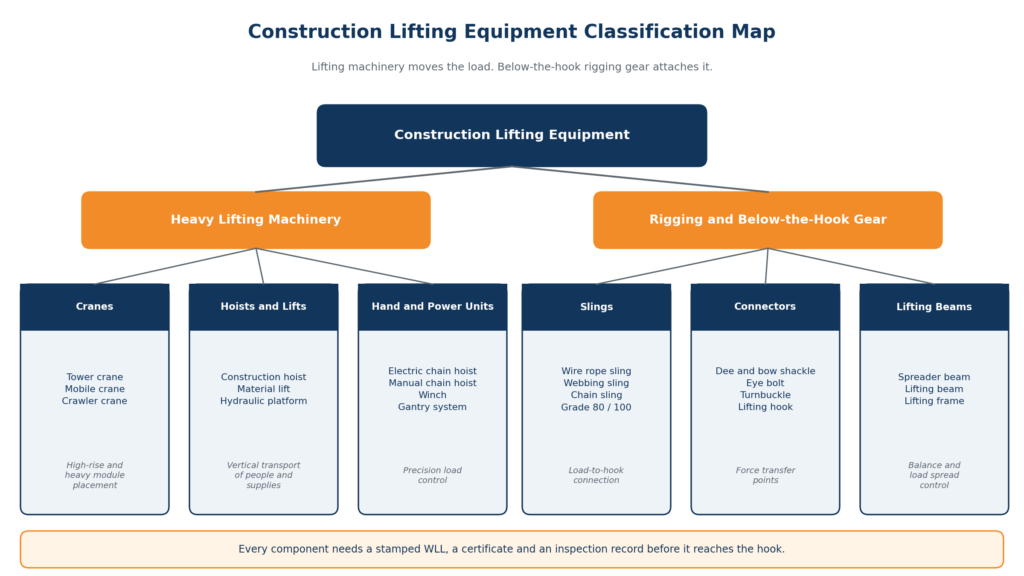
Most UAE projects combine tower cranes for high-rise placement, mobile and crawler cranes for heavy modules, construction hoists for vertical movement of people and supplies, and chain hoists, winches, and gantries for precision control. Selection depends on lift height, working radius, load weight, ground conditions, and site access.
No single machine covers every lift. A high-rise in Dubai Marina, a viaduct in Abu Dhabi, and a plant shutdown in an industrial zone each demand different reach, capacity, and duty cycles. The table gives indicative ranges for planning.
| Lifting equipment type | Typical capacity range | Typical construction application |
|---|---|---|
| Tower crane | 4 to 25 t maximum, 1 to 4 t at jib tip on mid-size units | High-rise material placement, formwork, rebar, precast panels |
| Mobile and crawler crane | 30 to 750 t class, larger units exist | Heavy modules, steel erection, plant installation, tower crane assembly |
| Construction hoist (rack and pinion) | 1,000 to 3,200 kg per cage | Workforce and material transport on multi-story jobsites |
| Material lift or mast hoist | 500 to 2,000 kg | Blocks, boards, and fit-out supplies |
| Electric chain hoist | 0.25 to 50 t | Steel alignment, plant setting, workshop handling |
| Manual chain hoist | 0.5 to 50 t | Light positioning, maintenance, sites without power |
| Winch (electric or hydraulic) | 1 to 20 t line pull | Controlled pulling and positioning |
| Overhead or portable gantry | 1 to 20 t | Workshops, precast yards, plant rooms |
Capacities are indicative. Always confirm against the manufacturer’s load chart and data plate.
How Do Tower Cranes and Mobile Cranes Differ?
Tower cranes are fixed to a foundation or the structure and lift materials to great heights with long reach, while mobile and crawler cranes travel across the site and set up quickly for heavy, short-duration picks. Tower cranes suit tall buildings; mobile cranes suit module placement and plant installation.
Tower cranes dominate high-rise work because they stay in place for months and cycle quickly over the building footprint. Their limits are wind exposure, jib interference with neighboring cranes, and a load chart that falls steeply as radius increases.
Mobile and crawler cranes need compacted, tested ground and properly sized outrigger mats or crawler platforms. Ground bearing pressure, not the nameplate capacity, often decides whether a heavy pick can proceed.
What Do Construction Hoists and Material Lifts Do?
Construction hoists carry workers and materials vertically along a mast fixed to the building facade, usually with a rack and pinion drive. Material lifts move supplies only, which frees the passenger hoist and removes crane hook time from routine deliveries such as blocks, boards, and fit-out packs.
Hoist planning starts before the facade closes. Landing gates, mast ties, and anchor points must coordinate with the structure, and cage capacity should reflect the peak fit-out load, not the average delivery. Teams planning tower crane and hoist equipment for Dubai towers should fix landing levels early.
Where Do Chain Hoists, Winches, and Gantries Fit?
Chain hoists, winches, and gantry systems provide controlled, short-range lifting where a crane is excessive or inaccessible. Typical uses include structural steel alignment, plant and pump installation, trench and basement work, and workshop handling, with capacities that usually range from 0.5 to 20 tonnes.
Electric chain hoists give fine hook-speed control for aligning steel beams or setting pumps onto bases. A 10,000 lb hydraulic winch suits controlled pulling and positioning where a crane cannot reach. Powered units also need a site supply plan, so check whether diesel generator sets will feed the temporary circuits.
Selection cues for hoists and winches:
- Duty class (FEM or ISO M rating) matched to daily operating hours
- Hook speed, lift height, and number of falls of chain or rope
- Brake design and thermal capacity for repeated short lifts
- Ingress protection of IP55 or higher for sandy sites
- Documented overload protection and limit switches
Which Rigging Hardware and Below-the-Hook Gear Do You Need?
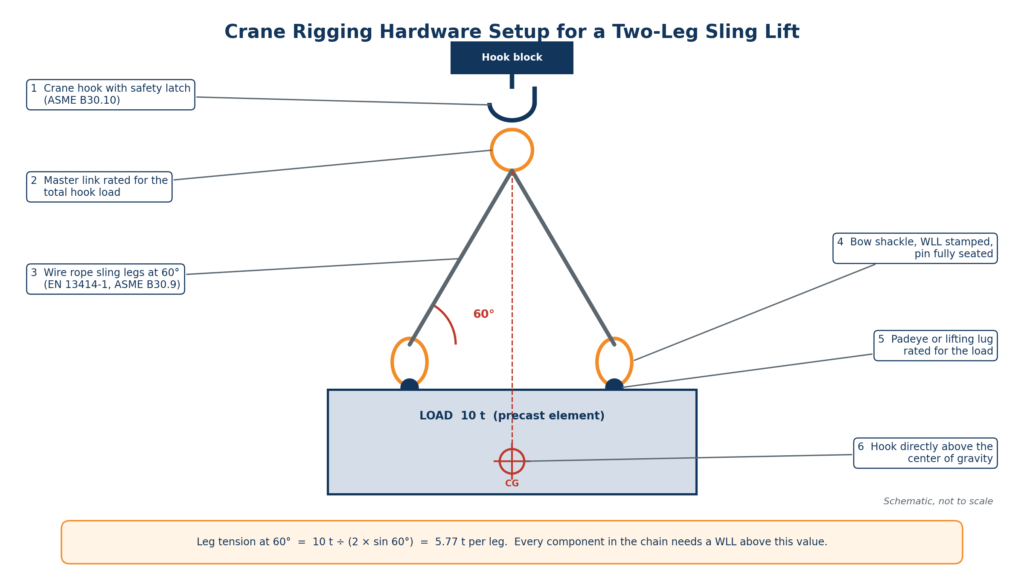
Rigging hardware connects the load to the lifting machine and includes slings, shackles, eye bolts, turnbuckles, hooks, and spreader beams. Each component must carry a stamped working load limit that equals or exceeds the load it sees, because the weakest element sets the capacity of the whole assembly.
A lift is only as strong as the lowest-rated component between the hook and the load. Procurement teams should therefore buy rigging as matched assemblies with traceable certificates, not as loose items sourced from different suppliers.
How Do Wire Rope, Webbing, and Chain Slings Compare?
Wire rope slings resist abrasion and heat, webbing slings protect finished surfaces and flex easily, and Grade 80 or Grade 100 alloy chain slings handle the harshest loads and high temperatures. Choose by load surface, temperature, edge sharpness, and the inspection regime your site can maintain.
| Property | Wire rope sling | Webbing sling | Alloy chain sling (Grade 80/100) |
|---|---|---|---|
| Abrasion and cut resistance | Good abrasion, fair against nicks | Low, cut by sharp edges | Excellent |
| Flexibility | Moderate | Highest | Good but heavy |
| Typical design factor | 5:1 | 5:1 (ASME), 7:1 (EN 1492-1) | 4:1 |
| Heat tolerance | Fiber core to about 100°C, steel core higher | About 80 to 100°C, fiber dependent | High, derate above 200°C |
| Surface protection | Can mark finished surfaces | Best | Marks finished surfaces |
| Best use | Structural steel, general rigging | Precast, facades, painted steel | Heavy, sharp-edged, hot loads |
| Main Gulf risk | Corrosion, dried-out lubricant | UV and heat degradation, grit | Corrosion, link and hook wear |
What Is the Difference Between Grade 80 and Grade 100 Chain?
Grade 100 chain carries about 25 percent more working load than Grade 80 chain of the same size, so teams can specify lighter slings for the same lift. Both grades are quenched and tempered alloy steel, but their fittings must match the chain grade, because mixing grades makes the lower-rated component the limit.
Wire rope and chain are the usual picks for hot, abrasive structural steel, while webbing protects finished facades and painted steel. Buyers comparing rigging hardware and slings across the GCC can review the Novawinch winch range and Stanley lifting equipment for rated options.
What Do Shackles, Eye Bolts, Turnbuckles, and Hooks Do?
These connectors transfer force between the sling, the load, and the crane hook. Dee shackles take in-line loads, bow shackles accept multi-leg slings and limited side loading, eye bolts need axial alignment, turnbuckles adjust tension, and latched hooks keep slings seated under load. Always match the component to the direction of pull.
- Dee shackles suit in-line pulls. Side loading cuts the WLL, so keep the pin seated and secured.
- Bow shackles accept multiple sling legs. Check the stamped WLL, and keep angular loading within the manufacturer’s limits.
- Eye bolts must be loaded in the plane of the eye with the shoulder seated. Angular pulls on a regular pattern bolt can cut capacity to about 30 percent at 45 degrees, so check the derating table.
- Turnbuckles adjust rigging length and tension. Use locking devices and keep the pull in line with the body.
- Lifting hooks need a working safety latch and the load seated in the bowl, not on the tip. Reject hooks with cracks, twist, or a throat opening that has grown by about 5 percent, or follow the manufacturer’s criteria.
Specifying a lifting kit for a new package? Review the certified lifting equipment range and run each assembly through the selection matrix later in this guide before you issue the purchase order.
How Do WLL, MBL, and Safety Factors Work?
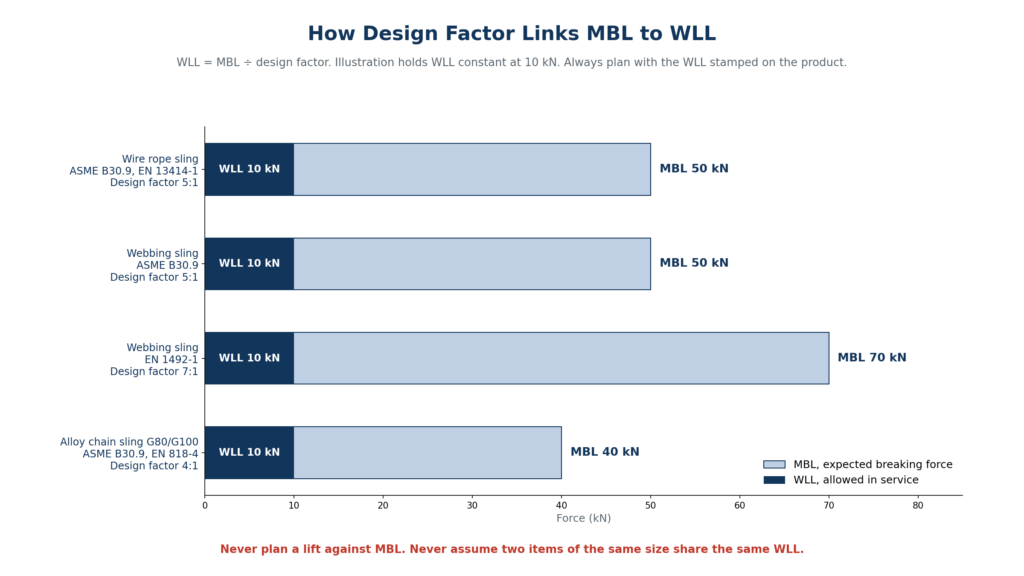
Working Load Limit (WLL) is the maximum load a component may carry in service, while Minimum Breaking Load (MBL) is the force at which it is expected to fail. WLL equals MBL divided by the design factor, so a 5:1 factor means a 50 kN MBL gives a 10 kN WLL.
The design factor is the safety margin built into the rating. Never plan a lift against MBL, and never assume two items of the same size share the same WLL.
Design factors that appear most often:
- Wire rope slings: 5:1 under ASME B30.9 and EN 13414-1
- Synthetic webbing slings: 5:1 under ASME B30.9, 7:1 under EN 1492-1
- Alloy chain slings (Grade 80 and 100): 4:1
- Shackles and forged fittings: commonly 5:1 or higher, so confirm by marking
Dynamic effects consume part of that margin. Shock loading, snatch lifts, and wind on large panels can multiply the effective load, so planners add allowances rather than relying on the factor to absorb them.
How Does Sling Angle Change Tension?
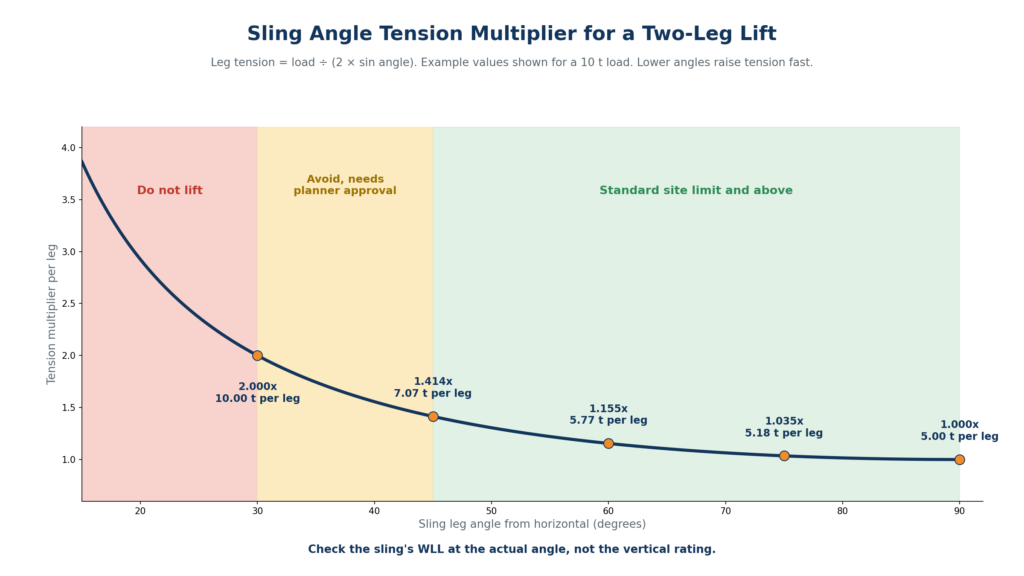
Sling tension rises as the angle between the sling leg and the horizontal falls. For a two-leg sling, each leg carries the load divided by twice the sine of that angle, so a 30 degree angle doubles the tension on each leg relative to a vertical lift.
| Angle from horizontal | Tension multiplier | Leg tension, 10 t load, two legs |
|---|---|---|
| 90° | 1.000 | 5.00 t |
| 75° | 1.035 | 5.18 t |
| 60° | 1.155 | 5.77 t |
| 45° | 1.414 | 7.07 t |
| 30° | 2.000 | 10.00 t |
Each leg’s tension must stay within its WLL at that angle, read from the tag or manufacturer chart. Many sites set 45 degrees as the working minimum, and no lift should go below 30 degrees.
How Do You Find the Center of Gravity and Distribute the Load?
Position the crane hook directly above the load’s center of gravity, then size and attach the slings so each leg carries a predictable share. If the hook sits off-center, the load tilts until it settles under the hook, which can overload one leg and swing the load toward people.
- Get the load weight and center of gravity from the manufacturer or drawings. Never guess for precast or machinery.
- Add the weight of slings, shackles, spreader beams, and blocks to the hook load.
- Choose lifting points placed symmetrically about the center of gravity.
- Set leg lengths and spreader width to keep leg angles at or above 45 degrees.
- Check the working radius against the crane load chart, including wind and dynamic allowances.
- For rigid loads on three- and four-leg slings, assume two legs carry the full load unless an engineer verifies equal sharing.
- Run a trial lift of a few centimeters, pause, and confirm the load is level.
How Do UAE Heat, Sand, and Salt Affect Lifting Gear?
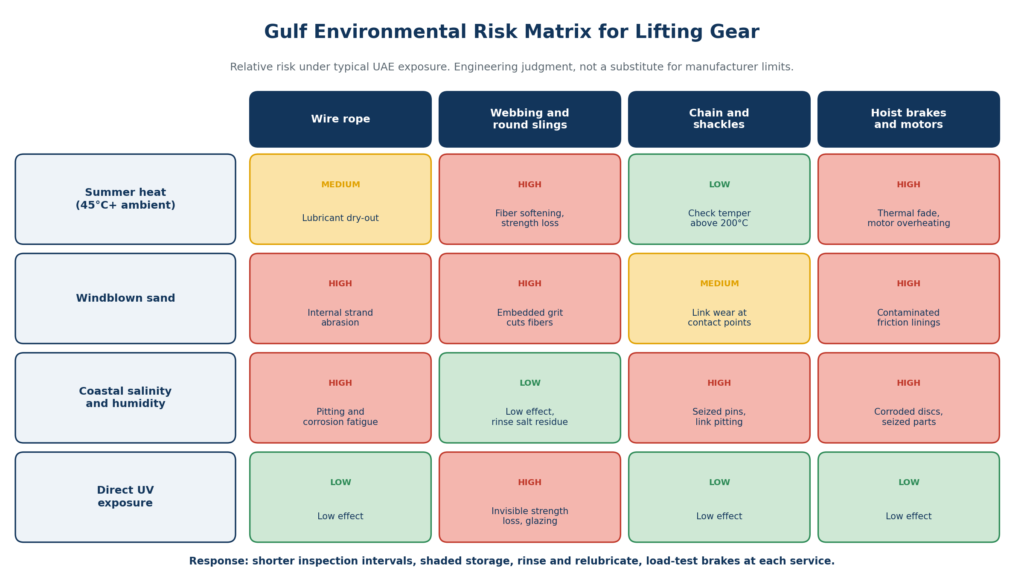
Extreme summer heat degrades lubricants and synthetic fibers, wind-blown sand abrades wire rope and webbing from the inside, and coastal salinity accelerates corrosion on wire, chain, and hoist brakes. These effects shorten inspection intervals and demand tighter storage, cleaning, and replacement criteria than temperate-climate guidance assumes.
| Gulf factor | Most affected gear | Typical failure mode | Control |
|---|---|---|---|
| Summer heat (45°C+ ambient) | Synthetic slings, rope lubricant, hoist motors | Fiber softening, lubricant migration, thermal fade | Shaded storage, temperature limits, duty-cycle derating |
| Windblown sand | Wire rope, webbing, chain, hoist gearboxes | Internal abrasion, contaminated brakes | Clean and relubricate, sleeves, sealed enclosures |
| Coastal salinity and humidity | Wire rope, chain, shackles, brake discs | Pitting, corrosion fatigue, seized pins | Galvanized or stainless parts, rinse, anti-seize, strict rejection criteria |
| Direct UV | Webbing and round slings | Hidden strength loss, glazing | UV covers, shaded storage, retire early |
Synthetic slings deserve extra attention. Direct sun can push dark steel surfaces well above the temperatures printed on the sling tag, and UV weakens fibers without obvious surface change. Store them in shade, away from chemicals, and retire them early if fibers look glazed or stiff.
Hoist brakes need similar scrutiny. Sand embedded in friction linings reduces holding torque, and salt-laden humidity corrodes discs overnight. Test the brake under a rated load at each service interval, not just with no load.
Which Standards and Inspections Apply on Dubai Construction Sites?
ASME B30 volumes, EN and BS product standards, and manufacturer manuals define how lifting equipment is designed, rated, and used, while Dubai Municipality and main-contractor requirements govern permits, operator competence, and inspection. Treat third-party examination and a documented daily check as the minimum evidence of control.
No single standard covers an entire lift. Use this reference set, and confirm the edition and any local requirements with the authority and the main contractor:
- ASME B30 series: B30.3 tower cranes, B30.5 mobile cranes, B30.9 slings, B30.10 hooks, B30.16 overhead hoists, B30.26 rigging hardware
- EN and BS product standards: EN 13414 wire rope slings, EN 1492 textile slings, EN 818 chain, EN 13889 forged shackles
- BS 7121: code of practice for safe use of cranes
- LOLER: UK regulations used as a benchmark for thorough examination periods
Official ASME editions are published through ASME codes and standards, and the HSE guidance on LOLER explains thorough examination in practical terms. Confirm permits and operator requirements with Dubai Municipality and the main contractor.
Check that the certificate of conformity, the test certificate, and the product marking agree on serial number, WLL, and standard. A mismatch means the item is not usable until the supplier resolves it.
What Should a Daily Pre-Use Checklist Include?
A daily pre-use check confirms that the equipment, rigging, and lift area are fit for the planned task before any load is raised. The operator or rigger inspects visible damage, markings, and function, tags defective items out of service, and records the result for the supervisor.
- Confirm the inspection tag or color code is current and matches the serial number on the certificate.
- Check that the WLL marking is legible on every sling, shackle, and hook.
- Inspect wire rope for broken wires, kinks, birdcaging, flattening, and corrosion.
- Inspect webbing for cuts, burns, UV glazing, chemical damage, and torn stitching.
- Inspect chain for stretch, gouges, bent links, and worn bearing points.
- Check hook latches, shackle pins, and eye-bolt seating.
- Test limit switches, brakes, and emergency stops without load.
- Verify ground conditions, outriggers, exclusion zone, wind speed, and signaller communication.
- Tag out defective gear immediately and record it.
When Is Third-Party Inspection Required?
Third-party inspection is required when a competent, independent examiner must certify lifting equipment before first use, after major repair, and at fixed intervals. Common practice follows LOLER-style periods of six months for lifting accessories and twelve months for most lifting machinery, unless the authority, manufacturer, or client specifies shorter periods.
A competent person should also examine gear after any incident, modification, or overload event, and before reuse after storage in extreme conditions. Keep a register that links every sling and shackle to its certificate, inspection date, and next due date.
How Do You Select Lifting Equipment for a Gulf Project?
Select lifting equipment by running every lift through five gates: load and geometry, equipment capacity and reach, rigging configuration, environment and duty cycle, and compliance evidence. A lift passes only when all five gates are documented, because a strong crane cannot compensate for a mis-rated shackle or an expired certificate.
| Gate | Key question | Evidence required |
|---|---|---|
| 1. Load and geometry | What are the true weight, center of gravity, shape, and lift points? | Weight certificate, drawings, center of gravity data |
| 2. Machine capacity and reach | Does the load chart at working radius exceed the gross load with margin? | Load chart, ground bearing check, crane certificate |
| 3. Rigging configuration | Does every component’s WLL exceed leg tension at the actual angle? | Rigging plan with sling angles, component certificates |
| 4. Environment and duty | Do heat, sand, wind, and salt change the rating or the inspection interval? | Site condition record, adjusted inspection interval |
| 5. Compliance and competence | Are certificates, inspection reports, and operator and rigger cards current? | Inspection reports, permits, competence records |
Score each gate pass or fail. Any fail stops the lift until the gap is closed and documented.
When you shortlist heavy lifting gear suppliers in the UAE, ask each one to supply the load chart, certificate, and WLL data for gates two and three. For plant that works alongside lifting operations, such as compressors and pumps, see our industrial machinery types and uses guide.
How Should UAE Teams Build a Safer Lifting Program?
Build the program around correct classification, verified WLL data, climate-adjusted inspection, and documented competence. Teams that treat lifting equipment in construction as a controlled system, not a pile of separate products, are better placed to avoid rejected certificates, unplanned stand-downs, and unclear accountability.
Start with a lift register that lists every machine and accessory, its certificate, and its next examination date. Add climate-adjusted inspection intervals, a rule on minimum sling angles, and a clear stop-work authority for riggers.
Use this guide on lifting equipment in construction types and uses as the baseline for your lift plans, then adapt it to each project’s loads and site conditions.
Ready to specify lifting gear with the right ratings and paperwork? Contact the Al Yaqeen Hardware team to discuss specifications, certificates, and delivery for your project.
Frequently Asked Questions About Lifting Equipment in Construction
What are the main types of lifting equipment in construction?
The main types are cranes (tower, mobile, crawler), hoists and material lifts, chain hoists and winches, gantry systems, and lifting accessories such as slings, shackles, hooks, and eye bolts. Machines move the load, while accessories attach it, and both need separate certification.
What is the difference between WLL and MBL?
WLL is the maximum load a rated component may lift in service, and MBL is the force at which a new component is expected to break. WLL is MBL divided by the design factor, and WLL is the only figure planners may use for lift calculations.
How often should lifting equipment be inspected in the UAE?
Inspect lifting equipment before every shift, and arrange formal third-party examination at the interval set by the authority, client, or manufacturer. A LOLER-style approach uses six-month periods for accessories and personnel-lifting equipment and twelve months for other machinery, and heavy heat, sand, or coastal exposure justifies shorter intervals.

Pingback: 5 Maintenance Tips to Extend Bar Bending Machine Life