
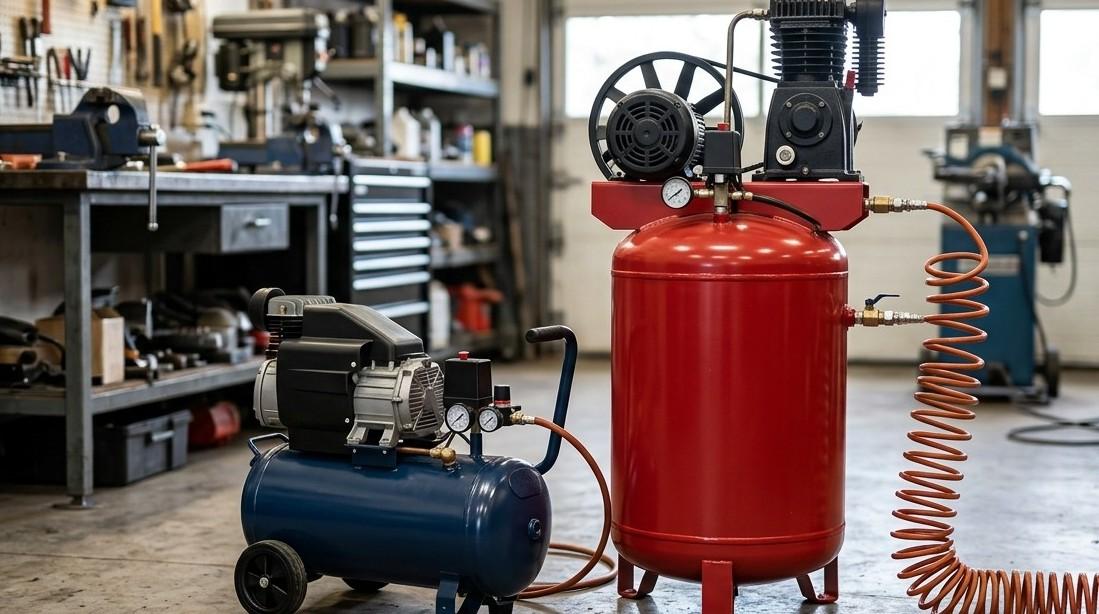
Air compressors power everything from a small home garage to a full scale factory floor. If you have ever tried to buy one without knowing where to start, you know how confusing the specs, sizes and technical terms can get.
This guide breaks it all down in plain language so you can pick a compressor that actually matches what you need, without paying for power you will never use.
What Is an Air Compressor and How It Works?
An air compressor is a mechanical device that pulls in ordinary air and squeezes it down into a smaller space. This process builds up pressure, which is then released in a controlled way to power tools and machines. Two numbers matter most when you look at any compressor.
PSI, or pounds per square inch, tells you how much pressure the unit can produce. CFM, or cubic feet per minute, tells you how much air volume it can deliver over time. Most buyers focus only on PSI, but CFM is usually the number that decides whether your tools will actually run properly.
Types of Air Compressors
Not every compressor works the same way inside. The internal mechanism affects noise, maintenance needs and how well it handles continuous use.
Reciprocating Compressors: These use a piston moving inside a cylinder, similar to a car engine. They are affordable, easy to repair and common in homes and small workshops, though they run hotter and louder than other types.
Rotary Screw Compressors: These use two interlocking helical rotors that compress air continuously. Since the rotors never touch, these units need less maintenance, run quieter and are built for nonstop industrial operation.
Scroll Compressors: These use one fixed and one orbiting spiral to compress air smoothly. They are known for oil free operation and near silent performance, which makes them popular in food processing, dental offices and electronics manufacturing.
Centrifugal Compressors: These rely on a fast spinning impeller to convert speed into pressure. They suit large facilities that need a high volume of air at lower pressure, such as power plants and refineries.
| Compressor Type | Best For | Noise Level | Typical Duty Cycle |
| Reciprocating | Home and small workshop use | High | Intermittent |
| Rotary Screw | Industrial and continuous operation | Low | Continuous |
| Scroll | Clean air applications | Very Low | Continuous |
| Centrifugal | Large scale facilities | Moderate | Continuous |
If you want to go deeper into how piston and screw models compare on cost and performance, our detailed piece on piston vs screw compressors walks through real workshop scenarios and helps you decide which one fits your budget.
How to Choose the Right Air Compressor?
Picking the correct size is more important than picking the biggest or cheapest model on the shelf. A few practical steps make this process much simpler.
Start by listing every tool you plan to run, then check each one’s required CFM at its operating PSI. Add these numbers together, then include a buffer of around twenty percent to account for leaks and friction loss in the hose or piping. This gives you a realistic minimum output your compressor needs to deliver.
Also think about how often the compressor will run. Tools used occasionally, such as a nail gun or tire inflator, do not need the same duty cycle as a sandblaster or spray gun used all day on a job site.
Key factors to review before buying include:
- Required air volume in CFM based on your combined tool list
- Working pressure in PSI or bar for your specific application
- Power supply available, since larger units often need three phase electricity
- Noise limits at your location, especially for indoor or residential use
- Whether your work needs oil free air, such as food, medical or paint applications
- Available space, since stationary tank models need permanent floor space
Common Applications and Air Requirements
Different tools and tasks need very different amounts of air. Here is a general reference so you are not guessing.
| Application | CFM Range | PSI Range |
| Tire inflation and home use | 1 to 3 | 70 to 150 |
| Spray painting | 4 to 8 | 30 to 50 |
| Nail guns and staplers | 1 to 2 | 70 to 90 |
| Impact wrenches and ratchets | 3 to 5 | 90 to 120 |
| Sandblasting | 6 to 25 | 70 to 90 |
| HVAC and refrigeration work | 3 to 12 | 60 to 100 |
These figures are a starting point. Always check the exact specification sheet for your tools, since two brands of the same tool type can have very different air needs.
Home Workshops Versus Industrial Systems
A homeowner inflating tires and fixing trim boards has completely different needs than a factory running production lines all day. Home and light workshop compressors are usually smaller, portable and single phase, designed for occasional bursts of use rather than constant operation.
Industrial systems, on the other hand, must be scalable. A plant’s air demand can double within a few years, so planning ahead matters. Businesses evaluating a long term setup should also think about air treatment such as dryers and filters, since dirty or wet air damages tools and shortens their lifespan.
If you are located in the region and comparing options, working with established air compressor suppliers UAE Sharjah gives you access to genuine parts, proper sizing advice and after sales support, all of which matter more than the sticker price over the life of the machine.
Maintenance That Extends Compressor Life
Even the best compressor will fail early without basic upkeep. Draining moisture from the tank daily, changing intake filters on schedule and checking oil levels on lubricated models are simple habits that prevent expensive repairs. Belts, hoses and fittings should also be inspected regularly for wear, since a small air leak quietly increases your energy bill over time.
For a broader look at how compressors fit alongside other equipment used across construction and manufacturing sites, our guide on industrial machines types and uses covers welding machines, generators and pumps that often work in the same setup.
Conclusion
Choosing the right air compressor comes down to matching your actual workload with the correct type, size and duty cycle rather than simply picking the cheapest or most powerful unit on the shelf. A homeowner inflating tires has very different needs from a workshop running impact tools all day or a factory operating continuous production lines.
Understanding CFM, PSI, air quality requirements and long term maintenance helps you avoid overspending while ensuring your tools and machines run reliably for years to come.
Looking for a Reliable Air Compressor Supplier in the UAE
Whether you need a compact unit for home projects, a rotary screw system for daily workshop use or a full industrial setup built for continuous operation, Al Yaqeen Hardware is a trusted air compressor supplier in the UAE, offering genuine products from leading brands along with expert guidance and dependable after sales support.
Contact our specialists today for tailored recommendations, competitive pricing and reliable air compressor solutions designed to meet your home, workshop or industrial needs.
Explore More Industrial Guides & Articles
If you are planning to upgrade or build your workshop or industrial setup, you may also find these guides helpful:
- How to Choose the Right Power Trowel for Your Concrete Project – Understand key selection factors for achieving smooth and durable concrete finishing results.
- Types of Welding Machines & How to Choose the Right One – Learn about different welding technologies and how to select the right machine for your application.
- I Tested 5 Diesel Pumps on Sites — Here’s What Worked – A practical comparison of diesel pumps based on real-world performance and efficiency.
- What Is an Industrial Vacuum Pump? Types and Their Uses: Rotary vane, diaphragm and liquid ring vacuum pumps explained for industrial and laboratory buyers.
- How Does an Induction Motor Work, Types and Uses: Explains how induction motors run, the single-phase and three-phase types, and where they are used in pumps, compressors and industrial machinery.

Pingback: How Does an Induction Motor Work, Types and Uses