
Hot summers, rapid construction and rising cooling demand have made backup power a standard requirement across UAE homes, workshops and warehouses. Yet many buyers still pick a generator by guesswork.
The result is either a unit that trips under load or one that burns fuel at a fraction of its capacity. Knowing how to calculate generator size prevents both outcomes.
This guide covers the kW and kVA formulas, starting-load multipliers, a worked example and the site conditions that change the final number. It suits facility managers, contractors and homeowners comparing diesel generators.
What Is Generator Sizing and Why Does It Matter?
Generator sizing is the process of matching a generator’s rated output, in kW or kVA, to the combined running and starting loads of your site. A correct generator size protects connected equipment, keeps fuel use efficient and prevents overload trips.
Undersizing causes voltage dips, shutdowns and stalled motors. Oversizing creates a different problem. Diesel engines running below roughly 30% load can suffer wet stacking, where unburned fuel builds up in the exhaust system.
The target is a unit that runs between 50% and 80% of its rated load during normal operation. Every sizing calculation depends on six inputs:
- Total running load in kW
- Largest motor starting load
- Power factor (usually 0.8)
- Phase configuration (single-phase 230V or three-phase 400V, 50 Hz)
- Site derating for heat and altitude
- Duty rating (standby, prime or continuous)
What Is the Difference Between kW and kVA?
kW measures the real power that does useful work, while kVA measures the apparent power a generator must supply to the site. The two connect through power factor, where kW equals kVA multiplied by power factor, and most diesel generators are rated at 0.8.
Kilowatts show what your equipment consumes. Kilovolt-amperes show what the alternator is built to deliver. Nameplates usually list both, and confusing them is one of the most frequent sizing errors.
Keep these formulas at hand:
- kW = kVA × 0.8
- kVA = kW ÷ 0.8
- kW = horsepower × 0.746
- Three-phase kVA = (1.732 × volts × amps) ÷ 1,000
How Do You Calculate Generator Size Step by Step?
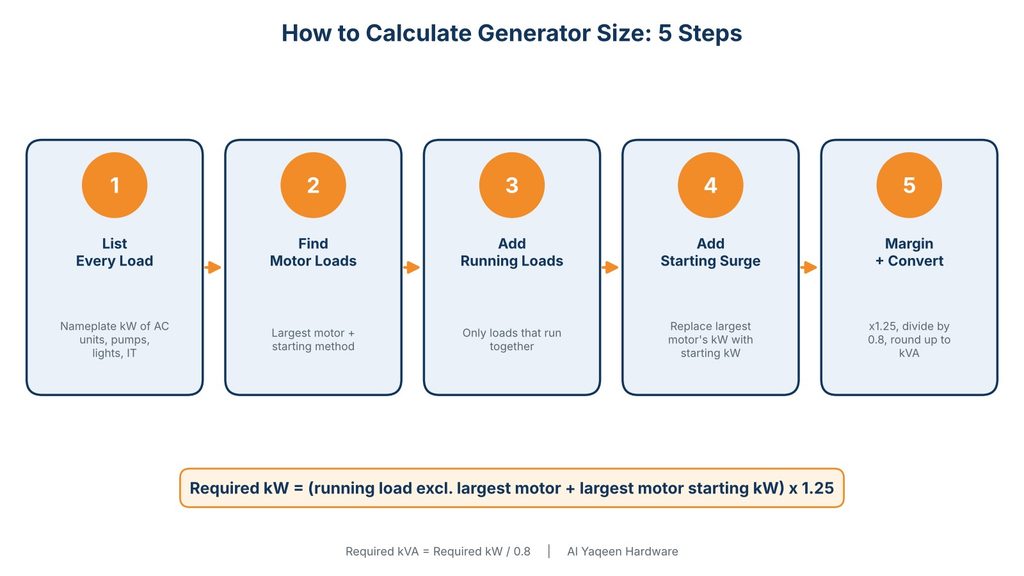
To calculate generator size, list every load, add the running watts, identify the highest starting surge, then apply a safety margin of 20 to 25 percent. Convert the final kW figure to kVA using a 0.8 power factor, then select the next standard generator rating.
- List every load. Record the nameplate running power of lights, AC units, pumps, compressors and IT equipment.
- Identify motor loads. Note the largest motor and its starting method: direct-on-line, star-delta, soft starter or VFD.
- Add simultaneous running loads. Sum only what runs at the same time, not everything installed on site.
- Add the starting surge. Replace the largest motor’s running kW with its starting kW.
- Apply margin and convert. Add 20 to 25%, divide by 0.8, then round up to the next standard kVA rating.
The working formula is: Required kW = (running load excluding largest motor + largest motor starting kW) × 1.25
What Does a Worked Generator Size Example Look Like?
A small workshop with 24 kW of running load and a 7.5 kW compressor needs about 61 kVA, which rounds up to a 62.5 kVA generator. The calculation adds the compressor’s starting surge to the remaining running loads, applies a 25% margin, then converts kW to kVA.
This example is illustrative. Always use nameplate values from your own equipment.
| Load | Running kW |
| Lighting and sockets | 3.0 |
| Four split AC units (2.0 kW each) | 8.0 |
| Water pump | 1.5 |
| Air compressor (largest motor) | 7.5 |
| Workshop tools | 4.0 |
| Total running load | 24.0 |
- Running load without the compressor: 24.0 − 7.5 = 16.5 kW
- Compressor starting load (3× with soft starter): 7.5 × 3 = 22.5 kW
- Peak demand: 16.5 + 22.5 = 39.0 kW
- With 25% margin: 39.0 × 1.25 = 48.75 kW
- Convert to kVA: 48.75 ÷ 0.8 = 60.9 kVA, so select 62.5 kVA
Normal running demand of 24 kW is about 48% of the unit’s 50 kW capacity. That sits comfortably above the wet-stacking threshold.
Why Do Starting Loads Matter More Than Running Loads?
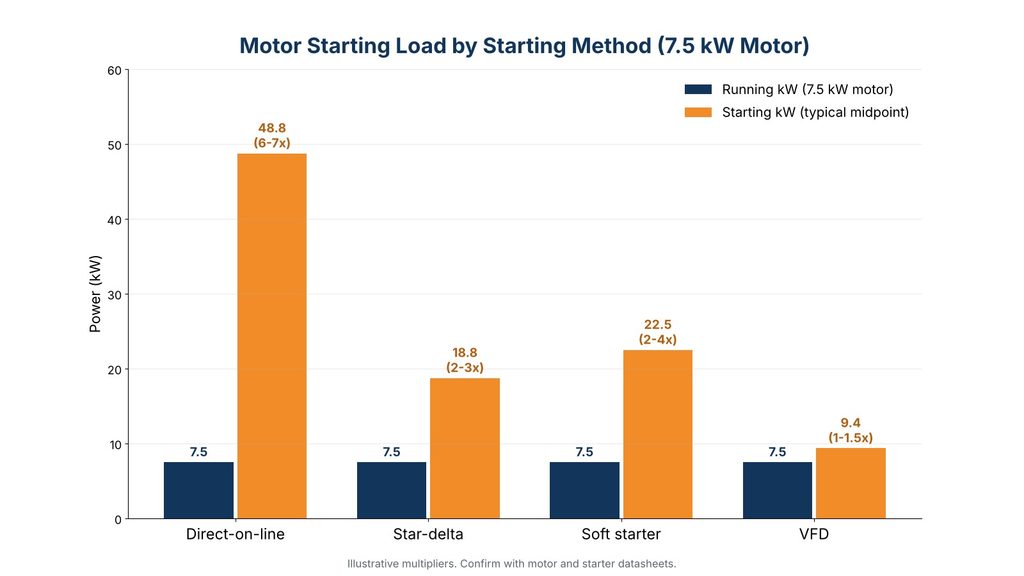
Electric motors draw three to seven times their running current for a fraction of a second at startup. The generator must absorb this surge without a voltage drop that stalls the load or trips protection, so the starting load usually decides the final generator size.
The starting method changes the surge dramatically. Choosing a soft starter or VFD can reduce the required generator capacity.
| Starting method | Typical surge multiplier |
| Direct-on-line | 6–7× |
| Star-delta | 2–3× |
| Soft starter | 2–4× |
| VFD | 1–1.5× |
Sequencing helps too. An automatic transfer switch (ATS) with time-delayed load stepping starts large motors one at a time instead of together.
Want to compare generator options before you decide?
Once you have your kVA figure, explore our range of commercial and industrial diesel generators. Compare power ratings, engine options and enclosure types to find a configuration that matches your load calculation and site requirements.
How Do UAE Site Conditions Change Generator Size?
High ambient heat, dust and humidity reduce the usable output of a generator below its nameplate rating. Manufacturers publish derating curves, so you should add capacity when site temperatures exceed the reference conditions defined in the ISO 8528 standard for generating sets.
ISO 8528-1 rates output at 25°C ambient, 100 kPa pressure and 30% humidity. UAE summer temperatures regularly exceed 45°C, and enclosed plant rooms run hotter still. The ISO standards for generating sets set out the testing and rating framework that manufacturers follow.
Check these factors before finalizing your generator size:
- Ambient temperature: Request the derating curve at your peak site temperature.
- Ventilation: Plant rooms need enough airflow for the radiator and combustion air.
- Altitude: Output falls as air density drops, which matters for elevated sites.
- Fuel quality: Contaminated diesel causes injector wear and unplanned shutdowns.
- Non-linear loads: UPS units and VFDs create harmonics and may require a larger alternator.
- Phase balance: Keep load across phases within about 10% of each other.
Local grid connection and change-over requirements may also apply, such as those set by SEWA in Sharjah. Confirm requirements before installation.
Which Rating Should You Choose: Standby, Prime or Continuous?
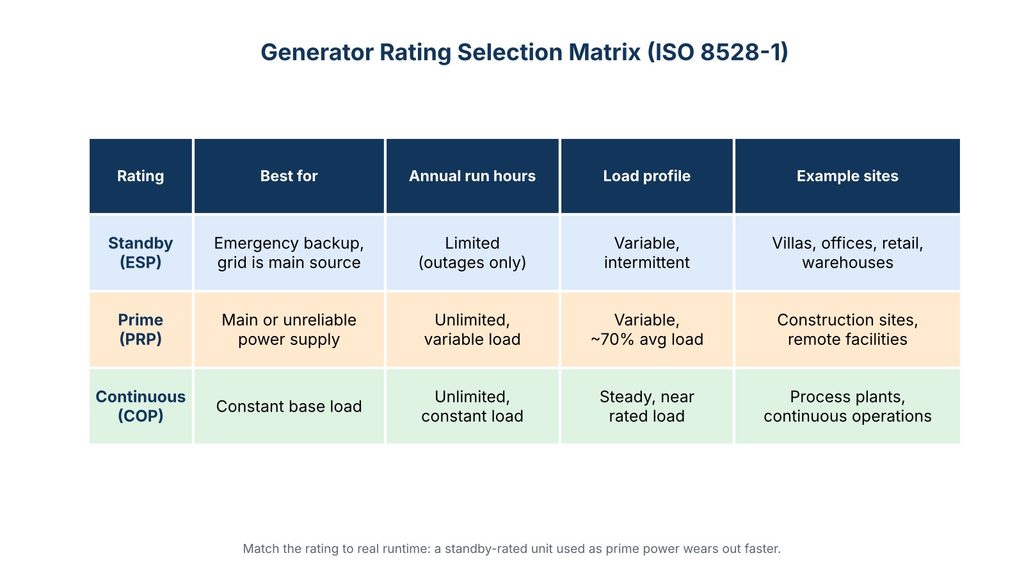
Standby rating suits emergency backup with limited annual running hours, prime rating suits variable loads with unlimited hours, and continuous rating suits constant base loads. Pick the rating that matches your real runtime, because a standby-rated unit used as prime power will wear out faster.
ISO 8528-1 defines these categories as emergency standby power, prime running power and continuous running power. The same physical engine carries different kVA ratings under each.
- Standby: Homes, offices, retail and buildings with grid power as the main source.
- Prime: Construction sites, remote facilities and locations with unreliable or no grid supply.
- Continuous: Process plants and sites that need constant output with little load variation.
Also plan fuel autonomy. At about 75% load, a diesel generator consumes roughly 0.27 litres per kWh, so tank size should match your longest expected outage.
What Are the Most Common Generator Sizing Mistakes?
The most common mistakes are sizing by running watts alone, ignoring motor starting surges, skipping the safety margin and forgetting site derating. Each error leads to overload trips or underloaded engines, so checking all four before purchase protects both equipment and fuel budget.
Use this six-point sizing audit before you approve any quote:
- Load list verified against nameplates, not estimates.
- Largest motor and its starting method documented.
- UPS, VFD and other non-linear loads flagged for alternator sizing.
- Phase balance checked across all three phases.
- Growth allowance of 15 to 20% added for planned expansion.
- Derating curve confirmed at your peak site temperature.
Maintenance matters as well. An annual load bank test confirms the generator delivers its rated output, and regular servicing keeps starting reliability high.
Is It Worth Calculating Generator Size Before You Buy?
Yes, calculating generator size is worth the effort for almost every buyer, because it takes under an hour and prevents costly mistakes. An overloaded unit fails during outages, while an oversized unit wastes fuel and wears the engine every month it runs.
Your intent decides how deep to go. A homeowner with a few AC units and pumps can use a quick load list and the 25% margin rule. A business with large motors, UPS equipment or critical operations should add starting-load analysis and a supplier-led review.
The takeaway is simple. Add up real loads, plan for the largest motor start, adjust for heat, then round up to the next standard rating.
Ready to confirm your generator size?
Share your load list with our team and receive a recommended kVA rating, rating type and configuration for your site. Whether your project is in Sharjah, Dubai or anywhere in UAE, our team can help you choose the right generator with confidence.
FAQs
What size generator do I need for a 3-bedroom villa?
Most villas fall between 25 and 50 kVA, depending on how many AC units, pumps and kitchen appliances run together. Use the load list method in this guide, include the largest motor starting surge, and add a 25% margin for an accurate figure.
How many kW is 100 kVA?
A 100 kVA generator delivers about 80 kW at a standard 0.8 power factor. Use the formula kW = kVA × 0.8. If your loads have a different power factor, check the generator datasheet for exact output.
What happens if a generator is too big or too small?
An undersized generator overloads, trips or fails to start motors. An oversized generator runs at low load, which can cause wet stacking, higher fuel use and engine wear. Aim for normal operation between 50% and 80% of rated capacity.




Leave a comment
Your email address will not be published. Required fields are marked *