
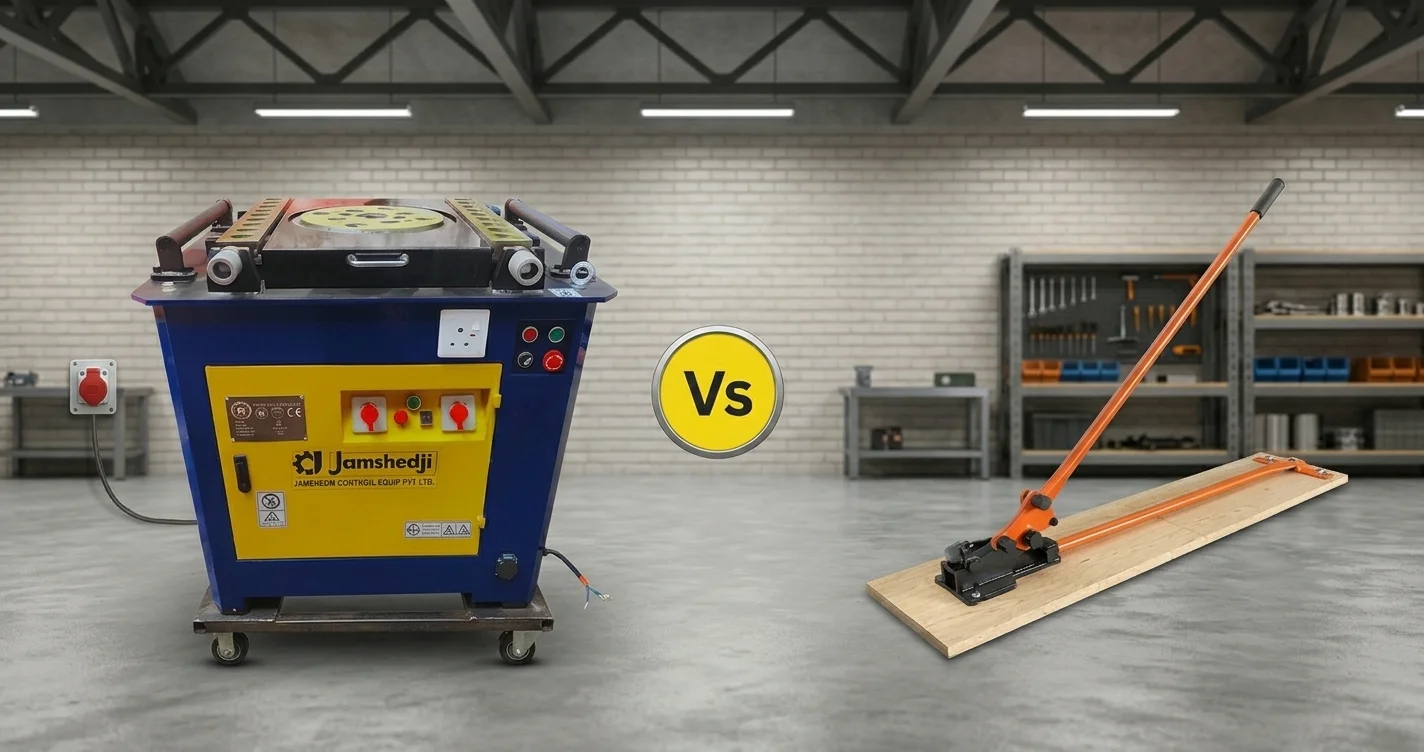
Manual bar bending machines are suitable for smaller construction jobs and occasional reinforcement work, while automatic machines are better for repetitive bending and higher production volumes. This guide compares their speed, accuracy, labour requirements, costs, maintenance and safety to help contractors choose the right machine for their project.
Bending reinforcement bars is an important part of preparing steel for concrete structures. Contractors need accurately shaped bars for columns, beams, slabs and foundations. The bending process must follow the structural drawings because incorrect angles or dimensions can create problems during reinforcement installation.
Choosing the right machine can make this work easier. However, not every construction project needs the same equipment. Manual machines can handle smaller workloads, while automatic machines are designed to improve production speed and consistency when bending large quantities of steel. Understanding the differences helps contractors select equipment that matches their daily requirements and budget.
What Is a Bar Bending Machine?
A bar bending machine is construction equipment used to bend steel reinforcement bars into specific angles and shapes. It helps prepare reinforcement according to structural drawings without relying entirely on manual tools and physical effort.
These machines are commonly used to prepare reinforcement for:
- Columns and beams
- Concrete slabs and foundations
- Stirrups and reinforcement hooks
- Bridges and road infrastructure
- Industrial and commercial buildings
The machine’s capacity depends on its design, motor power, bending mechanism and supported steel diameter. Choosing the right equipment helps maintain consistent bends and reduces unnecessary handling during reinforcement preparation.
Manual Bar Bending Machines
A manual bar bending machine requires direct operator involvement to position and bend reinforcement bars. Depending on its design, the operator uses a lever, handle or mechanical arrangement to apply the required force.
These machines are generally suitable for small construction projects where bending quantities are limited. They are also useful for repair work and locations where a powered machine may not be practical.
Benefits of Manual Bar Bending Machines
Lower Initial Investment
Manual machines generally cost less than automatic equipment. They are a practical option for small contractors who do not need to process large quantities of reinforcement every day.
Simple Operation
Their operating mechanisms are relatively straightforward. Workers can learn the basic bending process without extensive technical training.
Easy Transportation
Compact manual equipment is easier to move between work areas. This is useful when bending requirements change across smaller construction sites.
Straightforward Maintenance
Manual machines have fewer mechanical and electrical components. Routine cleaning, lubrication and inspection can help keep them in working condition.
Limitations of Manual Machines
Manual equipment also has limitations that contractors should consider before purchasing.
- Lower production speed: Each bending operation requires more direct operator involvement.
- Physical effort: Repeated bending can cause fatigue during longer working shifts.
- Operator-dependent accuracy: Results can vary depending on the worker’s experience and measurement technique.
- Limited capacity: The maximum bar diameter depends on the machine’s design and mechanical strength.
- Higher labour requirements: Larger workloads may require additional workers and more operating time.
Manual equipment works well when production requirements are limited. However, it can become inefficient when a project requires hundreds of similar bends within a short period.
Automatic Bar Bending Machines
An automatic bar bending machine uses a motor-driven mechanism and control system to perform bending operations with less manual effort. Depending on the model, operators can select bending angles and operating settings through a control panel.
Some machines provide automatic angle control, while advanced CNC models can store bending programmes for repeated shapes. These capabilities vary by model, so buyers should check the manufacturer’s specifications before selecting equipment.
Benefits of Automatic Bar Bending Machines
Faster Production
Automatic equipment can process repetitive bending jobs more efficiently. This helps construction teams prepare reinforcement without spending excessive time on individual bars.
Consistent Bending Results
Machines with automatic angle controls can produce repeatable bends when correctly configured. This is useful when preparing multiple reinforcement bars with identical dimensions.
Reduced Physical Effort
Motor-driven operation reduces the physical work required from operators. Workers can focus more on positioning, monitoring and handling reinforcement.
Suitable for Larger Workloads
Depending on their rated capacity, automatic machines can support demanding construction and fabrication operations.
Limitations of Automatic Machines
Despite their productivity benefits, automatic machines also involve additional requirements.
- Higher purchase cost: Motorised and advanced control systems generally require a larger initial investment.
- Power dependency: Electric models need a suitable and stable power supply.
- Technical maintenance: Motors, electrical systems and control components require proper inspection.
- Operator training: Workers must understand the controls, settings and safety procedures.
- Space requirements: Larger machines need sufficient operating and material-handling space.
Automatic equipment is generally a better fit when regular production demand justifies the additional investment.
Manual vs. Automatic Bar Bending Machines: Key Differences
The main difference is the level of operator involvement and the amount of work each machine can handle efficiently. Manual equipment offers simplicity for smaller jobs, while automatic equipment supports faster and more repeatable bending for larger workloads.
| Comparison Factor | Manual Machine | Automatic Machine |
| Operation | More manual involvement | Motor-driven operation |
| Initial Cost | Generally lower | Generally higher |
| Production Speed | Lower | Higher |
| Bending Accuracy | Depends on operator | More repeatable with proper settings |
| Labour | More physical involvement | Reduced physical effort |
| Bar Capacity | Depends on machine design | Depends on machine design |
| Maintenance | Generally simpler | More technical components |
| Power Supply | Depends on design | Requires electricity |
| Best Application | Small projects | Medium and large workloads |
Speed and Daily Production
Production speed is an important consideration when comparing the two machines. Manual bending takes more time because workers must control each operation. This can be manageable when only a limited number of reinforcement bars need processing.
Automatic equipment can complete repetitive bending operations with less manual intervention. For example, a contractor preparing identical stirrups for several floors may benefit from automatic angle settings and consistent production.
The actual output depends on bar diameter, bend angle, machine capacity, operator experience and material handling.
Bending Accuracy and Consistency
Accurate bending helps reinforcement bars fit the dimensions specified in structural drawings. With manual equipment, workers must measure and control the bending process carefully.
Automatic machines can reduce variations by using preset angles and controlled bending mechanisms. However, automation does not remove the need to check finished bars. Incorrect settings, unsuitable tooling or improperly positioned reinforcement can still produce inaccurate results.
Labour and Operating Costs
Manual machines usually require more physical involvement from workers. When production increases, contractors may need additional labour to maintain the required output.
Automatic equipment reduces repetitive physical work and can help operators process more reinforcement within the same shift. However, its higher purchase price, electricity consumption and maintenance costs must also be included when calculating the overall investment.
Which Machine Is Suitable for Your Construction Project?
The right choice depends on how frequently you bend reinforcement, the bar sizes you handle and the production schedule.
Manual machines are suitable for:
- Small residential construction projects.
- Renovation and repair work.
- Occasional reinforcement bending.
- Sites with limited power availability, where the machine design permits manual operation.
- Contractors with lower production requirements.
Automatic machines are suitable for:
- High-rise building construction.
- Bridges and infrastructure projects.
- Large commercial developments.
- Repetitive reinforcement fabrication.
- Construction workshops handling regular bending orders.
For example, a small contractor preparing reinforcement for a few residential columns may not need advanced automation. A fabrication workshop supplying reinforcement for multiple construction sites may benefit from a machine with automatic controls.
Factors to Consider Before Buying a Bar Bending Machine
Before selecting equipment, compare your actual working requirements rather than choosing a machine based only on its price or automation level.
1. Maximum Bar Diameter
Check the maximum steel diameter supported by the machine. Also consider the steel grade because higher-strength reinforcement may require greater bending force.
2. Daily Production Requirements
Estimate how many bars and bends your team needs to complete during a normal working shift. This helps determine whether manual or automatic operation is more practical.
3. Bending Angles and Shapes
Review your reinforcement drawings to identify the angles and shapes required. Check whether the machine can produce those bends without additional tooling or complicated adjustments.
4. Motor Power and Electrical Supply
For electric machines, verify the motor rating, voltage, phase requirements and available site power before purchasing.
5. Spare Parts and Technical Support
Check the availability of replacement pins, rollers, electrical components and servicing support. Access to suitable spare parts can reduce downtime during busy construction periods.
Contractors looking for suitable equipment can explore the available steel bending machines and compare the available options against their project requirements.
Maintenance and Safety Considerations
Both manual and automatic machines need regular maintenance. Poor maintenance can affect bending performance, increase equipment wear and create avoidable safety risks.
Basic Maintenance Checklist
| Frequency | Maintenance Task |
| Daily | Remove steel debris and inspect the machine before use. |
| Weekly | Check moving parts, bending pins and mechanical connections. |
| Monthly | Inspect electrical connections, motor condition and lubrication points. |
| As Required | Replace worn components and arrange professional servicing. |
Always follow the manufacturer’s maintenance instructions for the specific machine model.
Safe Operating Practices
Operators should wear suitable protective equipment, including safety footwear, gloves and eye protection. Keep hands away from rotating discs, bending pins and other moving components during operation.
Before starting a bending cycle, check that the reinforcement is correctly positioned and that the machine is stable. Never exceed its rated capacity or attempt to adjust moving components while the machine is running.
Automatic machines should also have accessible emergency stop controls where specified by the manufacturer. Proper operator training and a clear working area are essential for both machine types.
Conclusion
The right choice is rarely about which machine is better in general. It is about which one fits your bar sizes, daily output, site power and team. Manual machines suit small and flexible work. Automatic machines suit large, repeat heavy jobs where speed and accuracy pay back the higher cost.
If you are still comparing manual vs. automatic bar bending machines for an upcoming project, the team at Al Yaqeen Hardware can help you shortlist a machine that matches your workload and budget.
Pick the right bar bending machine the first time
Tell us your bar sizes, daily volume and site conditions, and our team will recommend a manual or automatic machine that fits your work. You get clear specifications and a written quote, with no guesswork before you buy.
Frequently Asked Questions
What is the main difference between manual and automatic bar bending machines?
Manual machines require more operator involvement, while automatic machines use motor-driven controls to perform bending operations with less physical effort. Automatic models are generally better for repetitive and higher-volume work.
Are automatic bar bending machines more accurate than manual machines?
Automatic machines can provide more consistent bending angles through preset controls. However, correct machine settings, suitable tooling and regular inspection are still necessary to achieve accurate results.
Which bar bending machine is better for small construction projects?
A manual machine is often suitable for small projects with limited reinforcement requirements. It offers simpler operation and a lower initial investment compared with more advanced automatic equipment.
What should I check before buying a bar bending machine?
Check the maximum bar diameter, bending angles, production capacity, motor power, voltage requirements, machine dimensions and spare parts availability. These specifications should match your actual construction requirements.
Do automatic bar bending machines require regular maintenance?
Yes. Automatic machines need regular cleaning, lubrication and inspection of their motors, electrical connections and control components. Follow the manufacturer’s maintenance schedule to maintain reliable operation.
Read More Blogs From Al Yaqeen Hardware
- Bar Bending Machine Benefits for Modern Construction Projects shows how the right bending equipment improves speed and accuracy on site, which pairs directly with the manual and automatic comparison.
- 5 Tips to Extend Your Bar Bending Machine’s Life shares practical upkeep habits that keep both manual and automatic machines running longer.
- Important Factors to Know Before Investing in Power Tools breaks down what to check on power source, safety and durability before you buy, which helps when weighing a powered machine.
- Industrial Machines: An Informative Guide to Types And Uses covers generators, welding machines, air compressors and pumps, useful if you are equipping a full site.
- Best Air Compressor Brands and Suppliers in UAE compares leading brands to help you pick the right compressor for your site. This is the weakest topical fit, so keep it last.

Leave a comment
Your email address will not be published. Required fields are marked *