
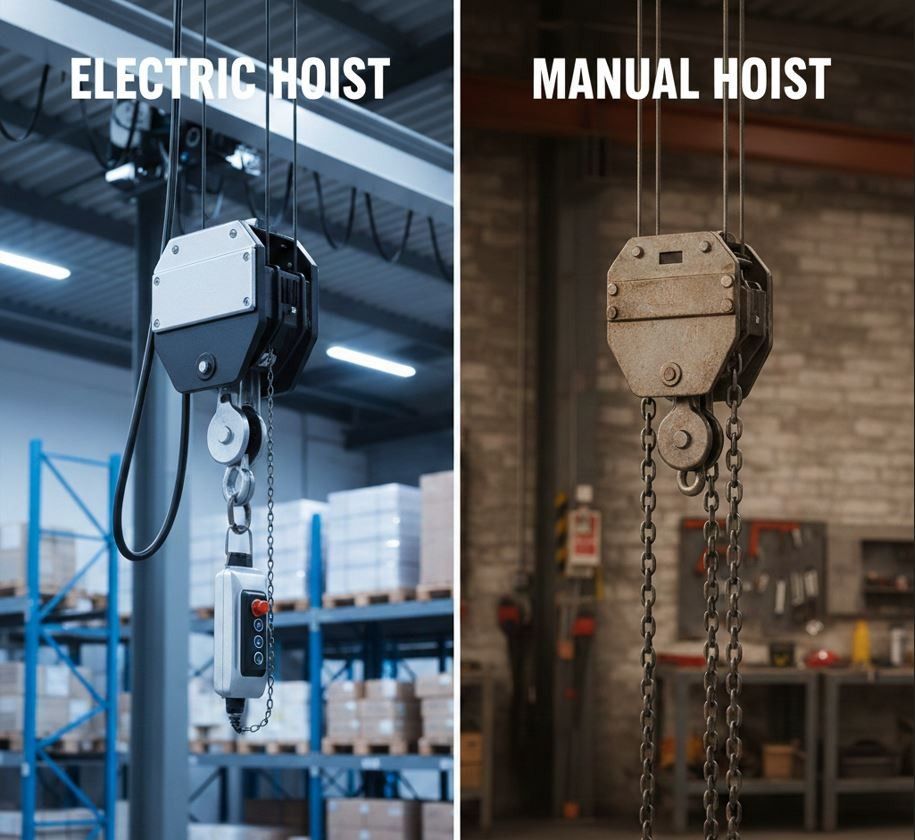
When it comes to lifting heavy loads in industrial settings, choosing the right hoist can make a substantial difference in efficiency, safety, and operational costs. Both electric hoists and manual hoists serve the same fundamental purpose, but their design, capabilities, and ideal applications vary significantly.
Understanding these differences is essential for warehouse managers, construction supervisors, and industrial procurement specialists aiming for optimized workflow and safer job sites.
What Is an Electric Hoist?
An electric hoist uses a motorized mechanism powered by AC or DC current to lift and lower loads with the push of a button. Operators control it via a pendant or wireless remote, delivering consistent lifting speeds regardless of load weight or shift duration.
Modern electric hoists come in chain or wire rope configurations and often include Variable Frequency Drives (VFD) for smooth, precise load control. If you are sourcing reliable units for your facility, browse our full range of lifting equipment to find the right specification for your operation.
What Is a Manual Hoist?
A manual chain hoist relies entirely on human effort. The operator pulls a hand chain that drives a gear system to lift the load. Lever hoists work similarly, using a ratchet mechanism that allows one-handed operation and angled pulling.
Manual hoists require no power source, making them ideal for remote sites, confined spaces, and emergency applications. Their simple mechanical design means low upfront cost, easy maintenance, and wide parts availability anywhere in the world.
Safety Comparison: Electric vs Manual
Automated Safety in Electric Hoists
Electric hoists with overload protection are equipped with load limiters, electromagnetic brakes, and upper/lower limit switches that trigger automatically when safe thresholds are exceeded. This layered safety architecture removes reliance on real-time human judgment during critical lifting moments.
In high-volume warehouse or plant environments, these safeguards significantly reduce the risk of dropped loads, chain failure, and operator injury. Brands like Novawinch engineer their electric winch systems specifically for these demanding, high-frequency industrial environments.
Operator-Dependent Safety in Manual Hoists
Manual hoists are safe tools but only when used correctly, within rated capacity, by a trained and physically capable operator. Fatigue, distraction, and improper rigging are the leading risk factors, none of which can be mechanically controlled.
That said, manual hoists do feature mechanical load brakes that hold a suspended load when chain tension is released. For occasional, low-weight lifts with trained personnel, they remain a proven and compliant industrial lifting solution.
Efficiency and Productivity
Speed and Throughput
Lifting speed is a direct output variable in any production or logistics environment. A standard electric hoist operates at 8 to 16 feet per minute consistently, shift after shift, while a manual hoist speed depends entirely on the operator and declines with fatigue.
For operations running multiple lift cycles per hour, the cumulative time difference is significant. A unit like the Novawinch 12,000lb heavy-duty electric hoist demonstrates exactly how motorized systems deliver repeatable performance that manual alternatives simply cannot match.
Ergonomics and Workforce Performance
Ergonomic lifting equipment is a measurable factor in reducing injury claims, absenteeism, and workforce turnover. Repeatedly pulling a hand chain across an eight-hour shift causes cumulative shoulder, arm, and back strain that compounds over weeks.
Electric hoists eliminate that physical burden, allowing operators to focus entirely on load control and site awareness. They also reduce dependency on experienced operators, delivering consistent results regardless of who is running the equipment.
Cost: Upfront Price vs Total Ownership Value
Manual hoists have a clear advantage in purchase price. A quality chain block costs a fraction of a comparable electric unit. For low-frequency or backup applications, that upfront saving is entirely justified and financially sound.
Electric hoists deliver lower total cost of ownership over time. Reduced labor hours, fewer injury-related costs, and higher throughput consistently offset the initial investment, especially in operations with daily, high-cycle lifting demands.
Application Fit: Choosing the Right Tool
Where Electric Hoists Perform Best
Electric hoists are the right choice for indoor manufacturing facilities, warehouses, and production lines where overhead crane and hoist systems run through multiple shifts. They excel with stable power supply, high lift frequency, and strict ergonomic or safety compliance requirements.
If your operation handles loads above two tonnes regularly or runs continuous duty cycles, a heavy-duty electric hoist rated H3 or above by HMI standards is the engineered necessity. Contact our experts to match the right specification to your application.
Where Manual Hoists Make Practical Sense
Manual hoists are the practical answer for remote construction sites, marine environments, and confined spaces where electrical supply is unavailable or unsafe. Their portability, corrosion-resistant variants, and zero-power requirement make them irreplaceable in these conditions.
For sites that need reliable pulling and load control without a power source, a hydraulic solution like the hydraulic winch 10,000lb offers a capable middle ground between manual effort and full electric operation. Portable lifting equipment like this keeps your team productive wherever the job takes them.
Maintenance Requirements
Electric Hoist Maintenance
Electric hoist maintenance covers motor insulation checks, brake system inspection, limit switch testing, control panel integrity, and chain or wire rope wear assessment. Modern units with self-diagnostic systems flag issues early, reducing unplanned downtime significantly.
Maintenance intervals follow ASME B30.16 in North America and EN 14492 in Europe. Explore our Stanley lifting equipment range for certified accessories and rigging tools that keep your hoist system compliant and fully operational year-round.
Manual Hoist Maintenance
Manual hoist upkeep is simpler by design, covering chain elongation checks, load brake testing, hook latch inspection, and gear lubrication as the core requirements. Parts are inexpensive, widely available, and inspections are manageable for qualified in-house technicians.
Both types fall under LOLER compliance requirements where applicable, mandating thorough examination every 6 or 12 months depending on application. Skipping scheduled inspections is where most avoidable lifting incidents originate.
Frequently Asked Questions
Is an electric hoist safer than a manual hoist?
Yes, electric hoists use overload protection, limit switches, and electromagnetic brakes to minimize human error. Manual hoists are safe only if operated correctly and within rated limits
What load capacity can a manual hoist handle?
Quality manual chain hoists are rated up to 20 tonnes WLL, sufficient for many industrial applications. For sustained high-capacity lifting, electric hoists provide more consistent and sound performance.
How do I select the right hoist for my site?
Assess maximum load weight, lift frequency, power availability, and environmental conditions before specifying equipment. Add a 20% safety margin and ensure electric hoist duty cycles match actual usage patterns.
What does duty cycle mean for electric hoists?
The duty cycle (H1–H5 per HMI standards) indicates how often an electric hoist can operate safely within a set period. Choosing a hoist with the correct duty cycle prevents overheating and ensures reliable performance.
Key Takeaways
Choosing between electric hoists and manual hoists depends on load requirements, operational frequency, safety needs, and budget. While manual hoists offer portability and low cost for light-duty lifting, electric hoists excel in safety, efficiency, and high-capacity operations.
Your Lifting Partner for Every Load, Every Site
From lifting machinery to material handling in industrial facilities, investing in the right hoisting equipment enhances operational efficiency and workplace safety. For reliable solutions tailored to your lifting needs, trust Al Yaqeen Hardware.
Contact our hoisting specialists to ensure the safest, most efficient solution for your site needs.
Expand Your Knowledge: Related Industry Guides
- Industrial Machines: An Informative Guide to Types and Uses: A practical overview of welding machines, compressors, generators, and pumps powering modern industry.
- Lifting Equipment in Construction: Types and Uses: From cranes to chain hoists, a complete guide to construction lifting equipment types and safe site applications.
- What Is an Industrial Vacuum Pump? Types and Their Uses: Rotary vane, diaphragm, and liquid ring vacuum pumps explained for industrial and laboratory buyers.
- How Does an Induction Motor Work, Types and Uses: Understanding single-phase and three-phase induction motors, their working principles, and real-world applications.
Leave a comment
Your email address will not be published. Required fields are marked *