
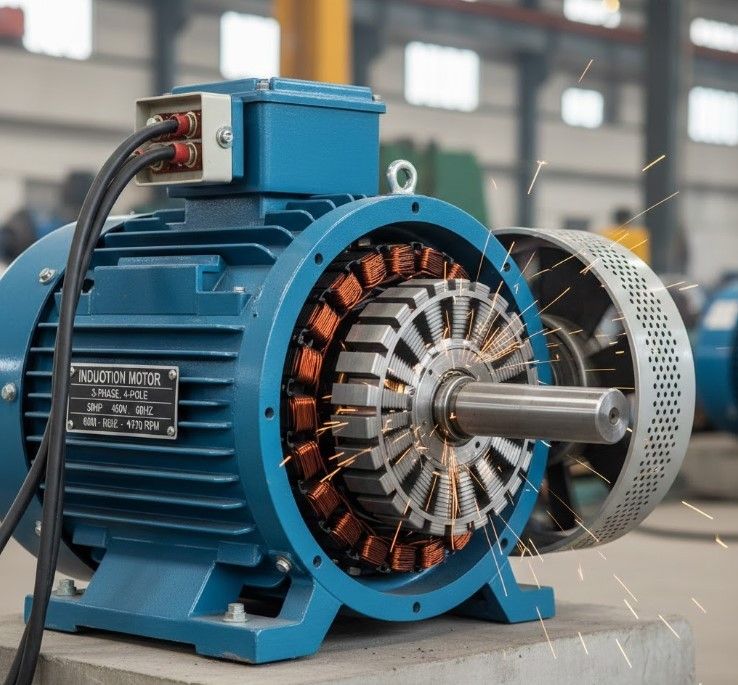
Induction motors are among the most widely used electric machines in modern electrical and industrial systems. They quietly power everyday equipment such as air conditioners, refrigerators, pumps, compressors, and ventilation units, while also serving as the driving force behind heavy manufacturing machinery and automated production lines.
Their widespread adoption is mainly due to simple construction, dependable long-term performance, low maintenance requirements, and the ability to operate directly on alternating current power that is readily available in homes, commercial buildings, and industrial facilities.
Understanding how an induction motor works does not require complex mathematics. Once the basic electromagnetic principle and internal structure are clear, it becomes easy to see why these motors dominate real-world applications.
This article explains the working mechanism, structural design, major types, and practical uses of induction motors in a clear and professional manner.
What Is an Induction Motor
An induction motor is an AC electric motor in which rotation is produced through electromagnetic induction in the rotor. Electrical supply is provided only to the stator windings. The stator creates a rotating magnetic field that induces current in the rotor conductors.
This induced current produces torque, causing the rotor shaft to rotate and deliver mechanical power to connected equipment. Because the rotor does not require direct electrical contact, induction motors do not use brushes or commutators.
This reduces mechanical wear, minimizes maintenance, and increases operational reliability, making the motor suitable for continuous duty in demanding environments.
Working Principle of an Induction Motor
When alternating current flows through the stator windings, it generates a magnetic field that rotates at synchronous speed. The rotor is placed inside this rotating magnetic field with a small air gap separating the two components.
As the rotating magnetic field cuts across the rotor conductors, it induces an electric current according to electromagnetic induction laws. The induced current creates another magnetic field within the rotor. Interaction between the stator and rotor magnetic fields produces electromagnetic force, which generates torque and causes continuous rotation of the motor shaft.
The rotor speed never reaches the exact synchronous speed of the magnetic field. The small difference between these speeds is known as slip. Slip is essential for maintaining induced current and sustained torque production inside the motor.
Structure of an Induction Motor
The internal construction of an induction motor mainly includes the stator, rotor, shaft, bearings, cooling system, and protective casing. Laminated silicon steel is used in both stator and rotor cores to reduce energy losses.
Copper windings in the stator generate the rotating magnetic field, while the rotor converts electromagnetic energy into mechanical motion.
Two common rotor designs are used in induction motors.
Squirrel Cage Rotor
This is the most widely used rotor type. Conductive bars made of aluminum or copper are short-circuited by end rings, forming a strong and compact structure. Squirrel cage motors are rugged, economical, and require very little maintenance, making them ideal for continuous industrial operation.
Wound Rotor
In this design, three-phase windings are connected to slip rings mounted on the rotor shaft. External resistance can be introduced to improve starting torque and control acceleration. These motors are typically used in heavy-load applications such as cranes, hoists, and elevators.
Types of Induction Motors
Induction motors are broadly classified based on the electrical supply used for operation.
Single-Phase Induction Motors
Single-phase motors are commonly used in residential and small commercial environments where only single-phase power is available. Because single-phase supply does not naturally create a rotating magnetic field, auxiliary starting methods such as capacitors or additional windings are required.
These motors are widely found in fans, refrigerators, washing machines, vacuum cleaners, and small water pumps where power demand is relatively low.
Three-Phase Induction Motors
Three-phase induction motors operate using three-phase AC supply, which naturally produces a strong rotating magnetic field. This enables self-starting capability, higher efficiency, smoother torque, and reliable continuous performance.
For this reason, three-phase motors are extensively used in conveyors, compressors, mixers, ventilation systems, machine tools, and automated manufacturing equipment.
Comparison of Three-Phase and Single-Phase Induction Motors
| Feature | Three-phase Motor | Single-phase Motor |
| AC Power Supply | Three-phase | Single-phase |
| Starting Method | Self-starting | Requires capacitor or auxiliary winding |
| Efficiency | High | Lower |
| Construction | More complex | Simpler |
| Maintenance | More difficult | Easier |
| Applications | Industrial and commercial equipment | Domestic and light-load devices |
Applications in Daily Life and Industry
Induction motors are present across nearly every sector of modern life. In homes, they provide motion for cooling systems, pumps, and airflow devices. Commercial facilities rely on them for escalators, refrigeration units, and service equipment.
Industrial plants depend heavily on three-phase induction motors to drive conveyors, grinders, mixers, packaging machinery, and ventilation systems required for continuous production. Their durability and efficiency make large-scale manufacturing and automated processing possible.
Advantages of Induction Motors
Induction motors offer several practical advantages. Their design is mechanically simple and robust. Absence of brushes reduces maintenance and increases service life. They operate efficiently for long durations and tolerate dust, vibration, and temperature variations.
Manufacturing cost is relatively low, allowing use in both small appliances and heavy industrial systems. Modern electronic drives further enhance performance through precise speed control and improved energy efficiency.
FAQs
What is an induction motor?
An induction motor is an AC electric motor that produces rotation using a rotating magnetic field and induced current in the rotor.
How does an induction motor work?
It creates a rotating magnetic field in the stator that induces current in the rotor, generating torque and mechanical motion.
Why is slip important in an induction motor?
Slip is the small speed difference between the magnetic field and rotor that allows continuous current induction and torque production.
What are the main types of induction motors?
The two primary types are single-phase induction motors for light loads and three-phase induction motors for industrial applications.
Where are induction motors commonly used?
They are widely used in household appliances, HVAC systems, pumps, conveyors, compressors, and manufacturing machinery.
Conclusion
Induction motors convert electrical energy into mechanical motion through electromagnetic induction created by alternating current in the stator. Their simple structure, reliability, efficiency, and wide application range make them the most commonly used electric motors worldwide.
From household appliances to heavy industrial machinery, induction motors remain essential to modern engineering and daily life. As technology advances, induction motors continue to become more efficient and versatile, reinforcing their importance in modern electrical engineering.
Browse Al Yaqeen Hardware to explore high-quality induction motors designed for a wide range of applications.

Leave a comment
Your email address will not be published. Required fields are marked *